The $25,000 Rule That Blocked Small Traders for 25 Years Is Finally Gone
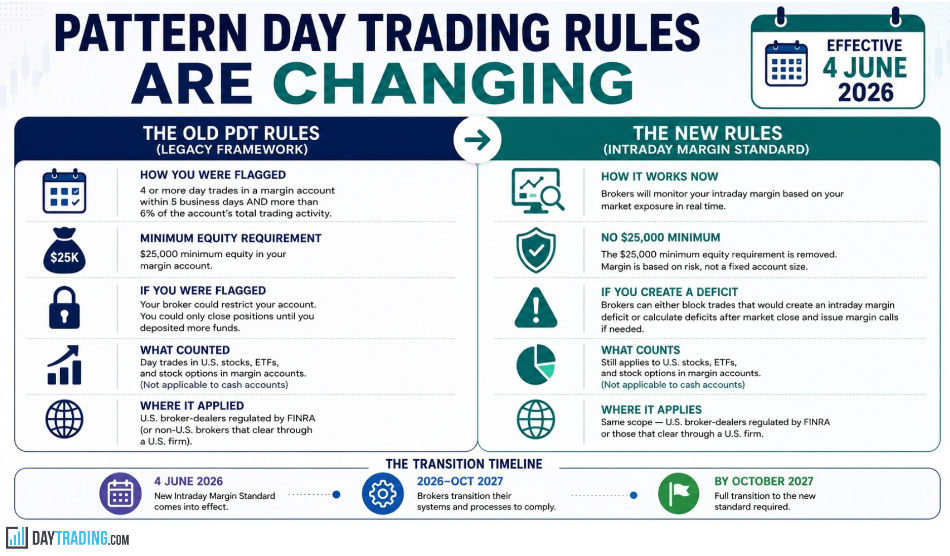
The Old Rule: For more than two decades, if you wanted to day trade a U.S. margin account more than a few times a week, you needed at least $25,000 sitting in it. This was called the Pattern Day Trader (PDT) rule — anyone who placed four or more day trades within five business days got flagged, and once flagged, they were locked out of further day trades unless their account held that $25,000 minimum.
The rule dated back to September 2001, introduced shortly after the dot-com crash, when regulators were worried about inexperienced traders overleveraging themselves. For years, traders argued it created an unfair line in the sand: someone with $24,999 was blocked from a fourth trade, while someone with $25,001 faced zero restriction.
Credit By: Daytrading.Com
What Changed:
On April 14, 2026, the SEC approved INRA's amendment to Rule 4210, formally eliminating both the PDT designation and the $25,000 minimum equity requirement. The new rules took effect June 4, 2026, replacing the old system with a risk-based intraday margin framework — instead of counting how many trades you make, brokerages now monitor your account's real-time risk exposure throughout the day.
Under the new framework, eligible margin accounts with as little as $2,000 can access intraday margin buying power, calculated by each brokerage based on your current positions.
Major brokers have already begun rolling this out — Charles Schwab confirmed it no longer flags accounts or counts day trades based on frequency, and E*TRADE implemented the change on June 9, 2026, meaning clients can now move in and out of positions intraday without triggering old restrictions.
Why This Matters for Traders:
This is one of the biggest accessibility shifts for retail traders in years. But easier access does not mean lower risk — if anything, the responsibility shifts more heavily onto the trader.
A few important things to know if you're trading (or thinking about trading) a small account under the new rules:
➤ This applies to margin accounts, not cash accounts. Cash accounts still operate under separate settlement rules — good faith violations and settled funds still apply.
➤ Brokers have until October 20, 2027 to fully implement this. Some brokers (like Schwab and E*TRADE) moved fast; others are still transitioning. Check your own broker before assuming the old rule no longer applies to you.
➤ Real-time risk monitoring replaces trade counting. Firms can now block a trade mid-day if it would create a margin deficit — so the constraint didn't disappear, it just changed shape.
➤ More access is not the same as more safety. With no cap on the number of day trades, the discipline question shifts entirely onto the trader: not "how many trades can I make," but "which trades are actually worth making."
Takeaway for Learners:
This is a great real-world case study in how regulation shapes trading behavior. For 25 years, a single number — $25,000 — decided who could actively trade and who couldn't. Removing that number doesn't just open a door for smaller accounts, it also removes a guardrail that, for better or worse, forced a lot of undercapitalized traders to slow down. The lesson worth sitting with: when a barrier to entry disappears, the real skill that separates good traders from bad ones becomes even more visible.
Let's learn together!