New cell-inspired material captures, stores, and releases energy in a single system/Nuevo material inspirado en las células captura, almacena y libera energía en un solo sistema
Source
A team of scientists from Northwestern University has created a liquid material that integrates energy capture, long-term storage, and on-demand release into a single system. This breakthrough, inspired by living cells, could simplify and enhance the sustainability of various energy technologies. The material is a yellow liquid that transforms into a gel upon absorbing energy. The process mimics the cellular cytoskeleton—an internal network that constantly assembles and disassembles, providing structural integrity to the cell.
Un equipo de científicos de la Universidad Northwestern ha creado un material líquido que integra en un solo sistema la captura, el almacenamiento prolongado y la liberación de energía bajo demanda. Este avance, que está inspirado en las células vivas, podría simplificar y hacer más sostenibles diversas tecnologías energéticas. Este material es un líquido amarillo que se transforma en un gel al absorber energía. El proceso imita el citoesqueleto celular, una red interna que se arma y desarma constantemente, dando consistencia a la célula.
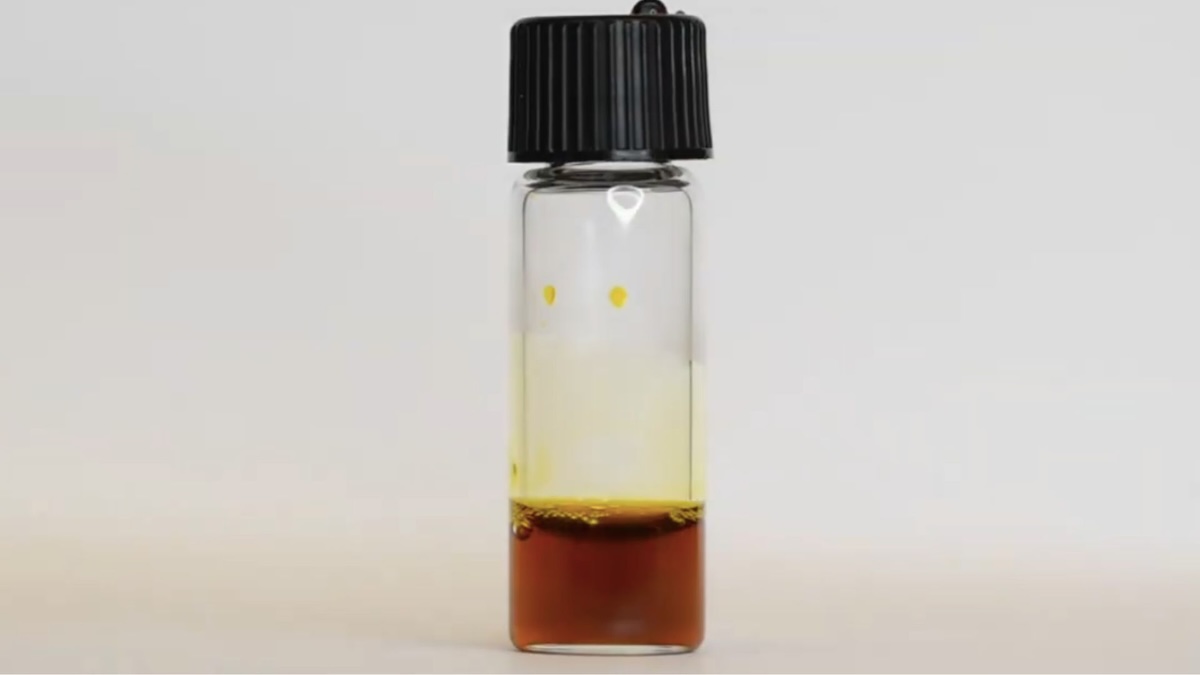
In its initial state as a yellow liquid, this material can absorb energy from various sources such as sunlight, electricity, X-rays, or chemical fuels. The absorbed energy triggers a molecular reaction that transforms the liquid into a black gel. This gel can store the energy stably for months. This change is driven by the custom-designed "ANI-MV" molecule: one part (ANI) captures energy and donates electrons to the other (MV), which stores them. This causes the molecules to link together, forming nanoscopic ribbons that intertwine to create the conductive gel.
Este material, en su estado inicial de líquido amarillo, puede absorber energía de diversas fuentes como la luz solar, la electricidad, rayos X o combustibles químicos. La energía absorbida provoca una reacción molecular que convierte el líquido en un gel negro. Este gel puede almacenar la energía de forma estable durante meses. Este cambio se debe a la molécula personalizada "ANI-MV". Una parte (ANI) capta la energía y dona electrones a la otra (MV), que los almacena. Esto hace que las moléculas se unan formando cintas nanoscópicas que se enredan y crean el gel conductor.
Source
When energy is needed, it can be extracted from the gel to drive chemical reactions—even in complete darkness—a capability known as "dark photocatalysis." Once the energy is released, the material reverts to its original liquid state upon exposure to atmospheric oxygen, making it ready for a new cycle. Its potential applications are vast and promising. It could offer an alternative to conventional batteries that relies on neither metals nor plastics, operates using water, and is repeatedly rechargeable.
Cuando se necesita la energía, se puede extraer del gel para impulsar reacciones químicas, incluso en completa oscuridad, una capacidad que denominan "fotocatálisis en oscuridad". Una vez liberada la energía, el material vuelve a su estado líquido original al exponerse al oxígeno del aire, quedando listo para un nuevo ciclo. Sus aplicaciones potenciales son muy amplias y prometedoras. Podría ofrecer una alternativa a las baterías convencionales que no utiliza metales ni plásticos, funcionando con agua y siendo recargable repetidamente.
Its creators estimate that a single gram of this material could store enough energy to charge a smartwatch. This feature would allow solar-powered chemical processes to continue operating in the absence of sunlight—a key advantage for green chemistry and industry. The material paves the way for the development of soft, adaptable electronics, programmable materials, and systems for environmental remediation (pollutant cleanup). Its ability to create microscopic conductive patterns that subsequently "disappear" upon resetting is of particular interest for the electronics of the future.
Sus creadores estiman que un gramo de este material podría almacenar suficiente energía para cargar un smartwatch. Esta característica permitiría que procesos químicos impulsados por energía solar continúen funcionando cuando no haya luz solar, lo que es una ventaja clave para la química verde y la industria. El material abre la puerta al desarrollo de electrónicos blandos y adaptables, materiales programables y sistemas para la remediación ambiental (limpieza de contaminantes). Su capacidad para crear patrones conductores microscópicos que luego "desaparecen" al reiniciarse es especialmente interesante para la electrónica del futuro.

Source
However, we must be prudent; the reality is that it is still in a very early stage of research and development, and the path from a laboratory discovery to a commercial product is often long and complex. The material has demonstrated its functionality at the laboratory scale. The next step—which often takes years—is to scale up production and test its performance, durability, and safety under real-world conditions. The material will likely need to be modified and optimized for specific applications, whether to improve efficiency, reduce costs, or adapt it for different uses.
Pero hay que ser prudentes, la realidad es que aún se encuentra en una fase muy temprana de investigación y desarrollo, y el camino desde un descubrimiento de laboratorio hasta un producto comercial suele ser largo y complejo. El material ha demostrado su funcionamiento a escala de laboratorio. El siguiente paso, que suele llevar años, es escalar su producción y probar su rendimiento, durabilidad y seguridad en condiciones del mundo real. Es probable que el material necesite ser modificado y optimizado para aplicaciones específicas, mejorando su eficiencia, reduciendo costes o adaptándolo a distintos usos.
The infrastructure required to manufacture the material in large quantities and cost-effectively must be designed and built. Furthermore, depending on the application (such as consumer electronics or energy storage), the product will need to meet safety and performance regulations and standards, as this type of process is common in nanoscience and materials science. Therefore, although this material represents a highly promising scientific breakthrough, the technology needed to turn it into an everyday product has yet to be developed.
Se debe diseñar y construir la infraestructura necesaria para fabricar el material en grandes cantidades y de forma rentable. Además, dependiendo de la aplicación (por ejemplo, para electrónica de consumo o almacenamiento de energía), el producto deberá cumplir con regulaciones y estándares de seguridad y rendimiento, ya que este tipo de proceso es habitual en la nanociencia y la ciencia de materiales. Por lo tanto, aunque este material es un avance científico muy prometedor, la tecnología necesaria para que sea un producto cotidiano aún está por desarrollar.
More information/Más información
https://interestingengineering.com/innovation/cell-inspired-material-eliminate-plastic-need
What a remarkable development! The ability of this new biomass-based material to provide a single material from which to capture, store and release electrical energy, as is done through living cells, is great evidence that Mother Earth has a lot to offer with the possibilities of fueling the future. While still only in laboratory form, the potential of this new electric battery to be used as an economical and ecological alternative, flexible and durable in many applications, including batteries and other alternate energy forms;and with these new innovations—it will be exciting to see how we can successfully mass-produce it and then demonstrate and confirm its long-term commercial viability.