China builds first wind-powered underwater data center/China construye el primer centro de datos submarino impulsado por el viento

Source
One of the bottlenecks for the development of artificial intelligence is energy, not only because it is necessary to generate it without destroying the planet but because we do not have the necessary electrical infrastructure to distribute it without detriment to existing users. That is why one of the practices that is becoming more common is to build both the data centers and the energy plants that will support them in the same complex. Along these lines, China has built the world's first underwater data center powered directly by offshore wind energy.
Uno de los cuellos de botella para el desarrollo de la inteligencia artificial es la energía, no solo porque es necesario generarla sin destrozar el planeta sino porque no tenemos la infraestructura eléctrica necesaria para distribuirla sin perjuicio de los usuarios existentes. Por eso una de las prácticas que se está volviendo más común es construir en el mismo complejo tanto los centros de datos como las plantas energéticas que los sustentarán. En esta línea, China ha construido el primer centro de datos submarino del mundo alimentado directamente por energía eólica marina.
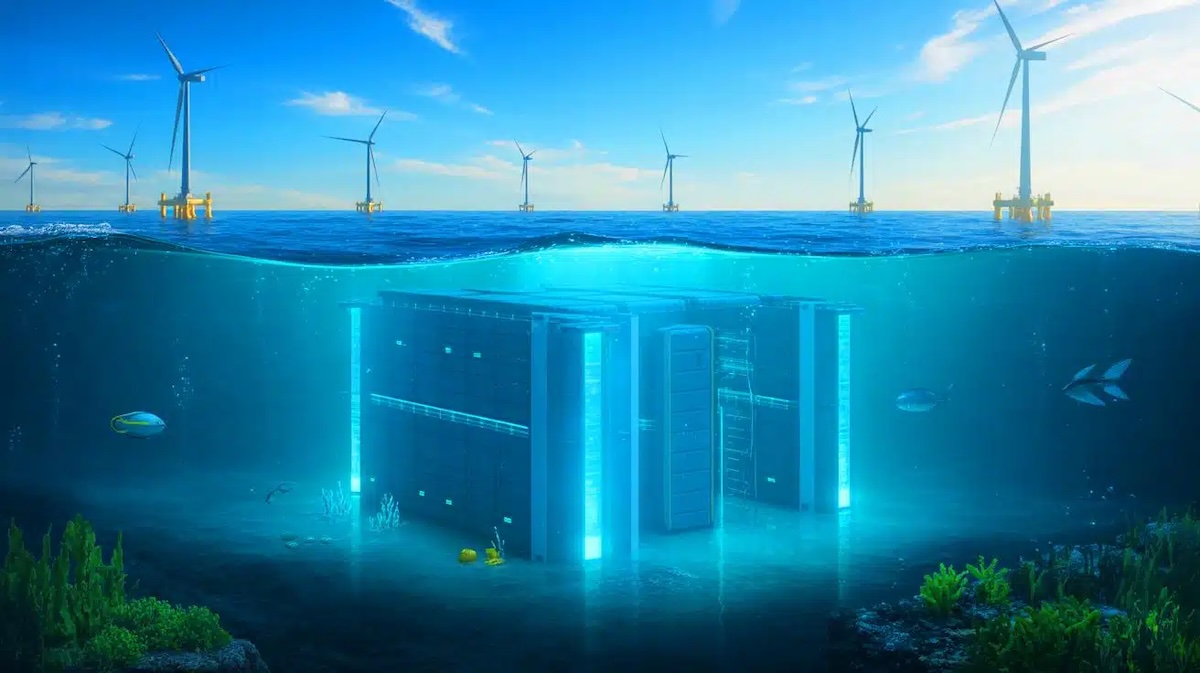
This system would be like a huge "hermetic" data center the size of a container, which will be installed on the seabed about 10 meters deep and 10 kilometers from the coast. This data center is located just 500 meters from a 200 MW offshore wind farm, therefore, the electricity produced by the wind turbines is connected directly to the data center through underwater cables, avoiding the losses of the traditional electrical grid and ensuring that more than 95% of the energy it uses is green.
Este sistema sería como un enorme data center "hermético" del tamaño de un contenedor, que será instalado en el lecho marino a unos 10 metros de profundidad y a 10 kilómetros de la costa. Este centro de datos está ubicado a solo 500 metros de un parque eólico marino de 200 MW, por lo tanto, la electricidad que producen los aerogeneradores se conecta directamente al centro de datos mediante cables submarinos, evitando las pérdidas de la red eléctrica tradicional y logrando que más del 95% de la energía que usa sea verde.

Source
But the most ingenious point is the natural cooling with sea water. Instead of using huge air conditioning systems that consume up to 40% of the electricity in a normal center, this Data Center uses sea water as a heat sink. The cold water (the average annual temperature in that area is only 15°C) circulates through a heat exchange system, cooling the servers without using a single liter of fresh water or extra electricity. Being at the bottom of the sea, the footprint on land is drastically reduced. A 2.3 MW underwater installation only needs about 200 square meters on land, while a traditional one would need about 2,000.
Pero el punto más ingenioso es la refrigeración natural con agua de mar. En lugar de usar enormes sistemas de aire acondicionado que consumen hasta el 40% de la electricidad en un centro normal, este Data Center utiliza el agua del mar como un disipador de calor. El agua fría (la temperatura media anual en esa zona es de solo 15°C) circula por un sistema de intercambio de calor, enfriando los servidores sin gastar un solo litro de agua dulce ni electricidad extra. Al estar en el fondo del mar, la huella en tierra se reduce drásticamente. Una instalación submarina de 2.3 MW solo necesita unos 200 metros cuadrados en tierra, mientras que una tradicional necesitaría unos 2.000.
The potential of this technology is very great, especially in a world where artificial intelligence demands more and more computing power, which translates into more energy. If adopted en masse, the impact would be enormous. A professor at Tsinghua University estimated that if all of China's data centers were underwater, it would save about 50 billion kWh per year (in cooling alone), equivalent to not burning 15 million tons of coal, making it a powerful tool to combat climate change.
El potencial de esta tecnología es muy grande, sobre todo en un mundo donde la inteligencia artificial demanda cada vez más potencia de cálculo, lo que se traduce en más energía. Si se adoptara de forma masiva, el impacto sería enorme. Un profesor de la Universidad de Tsinghua estimó que, si todos los centros de datos de China fueran submarinos, se ahorrarían unos 50 mil millones de kWh al año (solo en refrigeración), equivalentes a no quemar 15 millones de toneladas de carbón, por lo que es una herramienta potente para combatir el cambio climático.
Source
But all that glitters is not gold, and experts point to several major challenges. Repairing a failed server requires submerging or raising the entire module to the surface, which is much more complicated than going to a clean room on land. Salt water is extremely corrosive. Although special coatings are used, the seals must be perfect to avoid short circuits. Additionally, some studies warn that they could be vulnerable to sound wave attacks. Although the promoters assure that the heat dissipated is minimal and does not affect marine life, several ecologists have urged caution.
Pero no es oro todo lo que reluce y los expertos señalan varios desafíos importantes. Reparar un servidor averiado requiere sumergirse o elevar todo el módulo a la superficie, lo cual es mucho más complicado que ir a una sala blanca en tierra. El agua salada es extremadamente corrosiva. Aunque se usan recubrimientos especiales, los sellos deben ser perfectos para evitar cortocircuitos. Además, algunos estudios advierten que podrían ser vulnerables a ataques con ondas de sonido. Aunque los promotores aseguran que el calor disipado es mínimo y no afecta a la vida marina, varios ecólogos han pedido cautela.
The water leaving the cooling system is slightly warmer, and the long-term impact of that localized heat on ecosystems is not well understood. But, in any case, this Chinese underwater data center is a real and functional prototype, pointing towards a future where the most advanced technology and respect for the environment can go hand in hand. Although it still has challenges to solve, it shows that it is possible to rethink from scratch how we build and power the internet in the era of artificial intelligence.
El agua que sale del sistema de refrigeración es ligeramente más cálida, y el impacto de ese calor localizado en los ecosistemas a largo plazo aún no se conoce bien. Pero, de cualquier forma, este centro de datos submarino chino es un prototipo real y funcional, que apunta hacia un futuro donde la tecnología más avanzada y el respeto por el medio ambiente pueden ir de la mano. Aunque todavía tiene retos por resolver, demuestra que es posible repensar desde cero cómo construimos y alimentamos internet en la era de la inteligencia artificial.
More information/Más información
https://www.wired.com/story/china-opens-worlds-first-wind-powered-underwater-data-center/
Let me comment and compliment the post:
Launched by China, the first-ever underwater data center uses wind energy and natural seawater to keep operating temperatures down. This new facility sits adjacent that 200MW wind farm, resulting in reduced energy usage, lower water consumption, and less of the need for space to create the center. Challenges related to corrosion as well as maintenance, and even environmental concerns, will still need attention; however, the demonstration of this type of facility provides an excellent example of how renewable energy can provide an environmentally friendly foundation for future cloud computing (AI infrastructure) and help create a more sustainable global internet.
0.00 SBD,
0.66 STEEM,
0.66 SP