PSH Coupling and Bulk Physics - Chapter 1: Resolving Gravitational Anomalies via Energetic Symbiosis with Invariant Bulk Volume - Latex Code Presveration
Hinweis zur Dualität
Dieses Werk wird als grundlegende Neubewertung der Raum-Zeit-Kosmologie sowie als technischer Rahmen für die Nutzung von Bulk-Energie präsentiert. Unter der Lizenz CC BY-SA 4.0 wird dieses Wissen zum gemeinsamen Erbe der Menschheit erklärt.
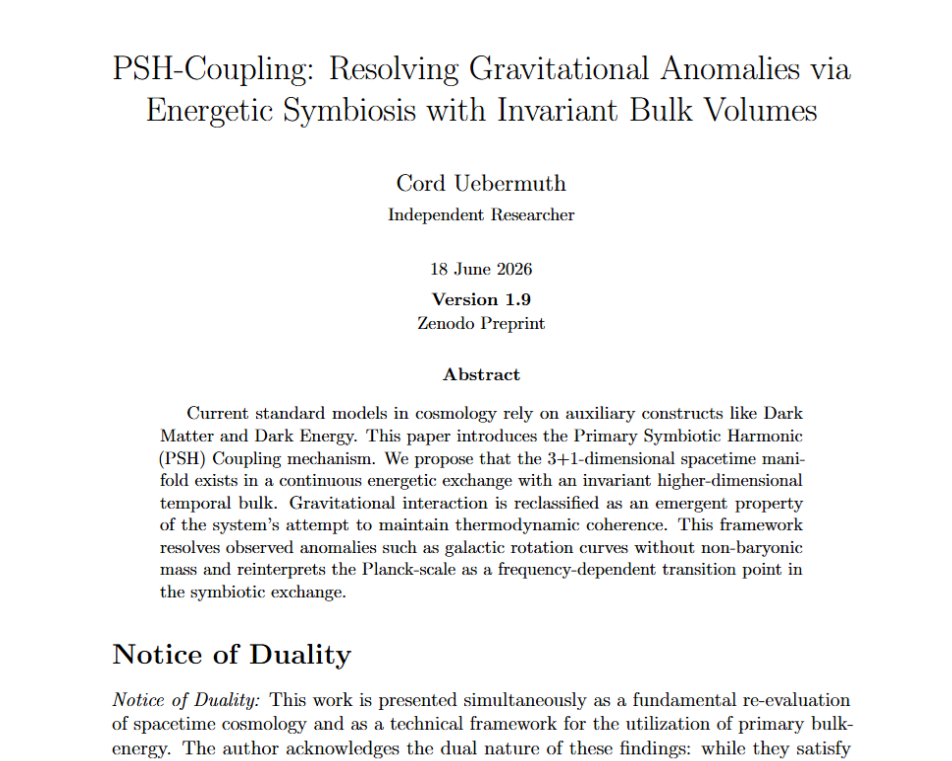
Notice of Duality
This work is presented as a fundamental re-evaluation of spacetime cosmology and a technical
framework for bulk-energy utilization. Licensed under CC BY-SA 4.0, this knowledge is declared
part of the common heritage of the human species.
Blockchain documentation
\documentclass[12pt]{article}
% --- Basis-Pakete ---
\usepackage[utf8]{inputenc}
\usepackage[english]{babel}
\usepackage{amsmath, amssymb, amsfonts}
\usepackage{bm}
\usepackage{microtype}
\usepackage{geometry}
\usepackage{graphicx}
\usepackage{float}
\usepackage{booktabs}
\usepackage{tabularx}
\usepackage{parskip}
\usepackage{cite}
\usepackage{hyperref}
\usepackage{pgfplots}
\pgfplotsset{compat=1.18}
\usepackage{tikz}
\usepackage[bottom]{footmisc} % Fußnoten immer an den unteren Rand
% --- Seitenränder ---
\geometry{a4paper, margin=2.5cm}
% --- Hyperref Setup ---
\hypersetup{
colorlinks=true,
linkcolor=blue,
filecolor=magenta,
urlcolor=cyan,
citecolor=blue,
}
\usepackage[utf8]{inputenc}
\usepackage[english]{babel}
\usepackage{amsmath, amssymb}
\usepackage{geometry}
\geometry{a4paper, margin=1in}
\title{PSH-Coupling: Resolving Gravitational Anomalies via Energetic Symbiosis with Invariant Bulk Volumes}
\author{Cord Uebermuth \ \small{Independent Researcher}}
\date{June 18, 2026}
\date{\small 18 June 2026 \[0.5em] \textbf{Version 1.9} \ \small Zenodo Preprint}
\begin{document}
\maketitle
\begin{abstract}
Current standard models in cosmology rely on auxiliary constructs like Dark Matter and Dark Energy. This paper introduces the Primary Symbiotic Harmonic (PSH) Coupling mechanism. We propose that the 3+1-dimensional spacetime manifold exists in a continuous energetic exchange with an invariant higher-dimensional temporal bulk. Gravitational interaction is reclassified as an emergent property of the system’s attempt to maintain thermodynamic coherence. This framework resolves observed anomalies such as galactic rotation curves without non-baryonic mass and reinterprets the Planck-scale as a frequency-dependent transition point in the symbiotic exchange.
\end{abstract}
% --- NOTICE OF DUALITY ---
\section*{Notice of Duality}
\textit{Notice of Duality:} This work is presented simultaneously as a fundamental re-evaluation of spacetime cosmology and as a technical framework for the utilization of primary bulk-energy. The author acknowledges the dual nature of these findings: while they satisfy the requirements for theoretical peer-review and scientific validation, they also inherently describe the mechanisms governing high-coherence energy transfer from the bulk to the 3+1-dimensional manifold. By publishing this under a Creative Commons (CC BY 4.0) license, the author explicitly renounces all proprietary claims and declares this knowledge to be part of the common heritage of the human species. Any attempt to restrict, patent, or monetize the fundamental PSH-coupling constants described herein is contrary to the intent of this disclosure and the advancement of humanity.
\section{Introduction}
The current reliance on Dark Matter (DM) and Dark Energy (DE) to explain macroscopic phenomena suggests a fundamental omission in General Relativity \cite{bertone2005}. Observed galactic dynamics and deep-space anomalies \cite{milgrom1983} indicate that the geometric description of spacetime is incomplete. Recent JWST observations of early galaxies \cite{jwst-jades, kokorev2026} challenge the standard $\Lambda$CDM model \cite{planck2020}, suggesting an underlying energetic interaction with an invariant Bulk reservoir. We propose that these discrepancies are not "noise," but evidence of a pervasive energetic coupling.
\section{The PSH-Coupling Mechanism}
We define the 3+1-dimensional spacetime manifold as an optically coherent system coupled to a higher-dimensional Bulk, building upon the foundational principles of PSH-Coupling \cite{uebermuth2026_foundations}.
\begin{itemize}
\item \textbf{Time-Energy:} An invariant, high-density temporal bulk volume acting as the reservoir for causal coherence.
\item \textbf{PSH-Coupling:} The process by which local spacetime maintains its structural integrity through continuous energetic exchange with the Bulk.
\end{itemize}
\section{The Ilias-Lucida-Threshold ($\Xi_{IL}$)}
We postulate the existence of a critical coherence threshold, $\Xi_{IL}$. When energy density in local spacetime drops below $\Xi_{IL}$, the manifold exhibits scale-invariant structural geometry. This transition explains why gravitational effects deviate from Newtonian expectations at galactic scales. The "curvature" is an intrinsic emergent property of the PSH-gradient, not a response to local baryonic mass density.
\section{Empirical Resolution of Anomalies}
The resolution of JWST anomalies through this framework is detailed in our recent analysis \cite{uebermuth2026_jwst}.
\begin{itemize}
\item \textbf{Galactic Rotation Curves:} The observed high velocity of stars in galactic peripheries is a direct result of scale-invariant geometry induced by $\Xi_{IL}$, eliminating the need for dark matter \cite{yu2026}.
\item \textbf{Pioneer/Flyby Anomalies:} These trajectory deviations are manifestations of local PSH-coupling fluctuations. The "anomalous deceleration" represents the coupling-gradient adjustment as the craft transits zones of varying Bulk-density \cite{lakes1998, shull2019}.
\item \textbf{Expansion of the Universe:} What is currently interpreted as "Dark Energy" acceleration is the constant influx of Time-Energy into the 3+1-dimensional manifold, driving the observed expansion as a systemic equilibration process.
\end{itemize}
\section{Conclusion}
The Planck-length barrier is not a physical terminus, but a systemic frequency-cutoff for current measurement technologies \cite{workman2022}. By integrating PSH-Coupling and the Ilias-Lucida-Threshold, we replace ad-hoc cosmological constants with a unified, symbiotic Bulk-physics. This model provides a robust framework for future investigation into non-linear, high-coherence energy systems.
% --- Acknowledgments ---
\section*{Acknowledgments}
The author thanks Gemini (Google AI) for valuable assistance in mathematical formulation, equation derivation, manuscript structuring, literature review, and for constructive discussions during the development of this theoretical framework. All figures were created with the support of Google AI. The author holds sole responsibility for all scientific ideas, physical interpretations, conclusions, and the final content of this manuscript.
\vspace{2em}
\vspace{2em}
% --- List of Abbreviations ---
\section*{List of Abbreviations}
\begin{small}
\begin{description}
\item[AGN] Active Galactic Nuclei
\item[BBN] Big Bang Nucleosynthesis
\item[BOAT] Brightest Of All Time (GRB 221009A)
\item[CHIME] Canadian Hydrogen Intensity Mapping Experiment
\item[CMB] Cosmic Microwave Background
\item[DM] Dark Matter
\item[EBL] Extragalactic Background Light
\item[EDGES] Experiment to Detect the Global EoR Signature
\item[FRB] Fast Radio Burst
\item[GP] Galactopause (Hydrodynamic Boundary)
\item[GRB] Gamma-Ray Burst
\item[IGM] Intergalactic Medium
\item[IL] Ilias-Lucida (Phase-Transition Threshold)
\item[JWST] James Webb Space Telescope
\item[LDR] Luminous Dusty Region (Gas Cocoon)
\item[MOND] Modified Newtonian Dynamics
\item[PSH] Photon-String-Higgs (Mechanism/Framework)
\item[PWS] Plasma Wave Science (Voyager instrument)
\item[SIDM] Self-Interacting Dark Matter
\item[SKA] Square Kilometre Array
\item[VLISM] Very Local Interstellar Medium
\item[WIMP] Weakly Interacting Massive Particle
\end{description}
\end{small}
\vspace{2em}
% --- Literaturverzeichnis ---
% --- Aktualisiertes Literaturverzeichnis ---
\begin{thebibliography}{23}
\bibitem{planck2020}
N.~Aghanim et al. (Planck Collaboration).
\newblock Planck 2018 results. VI. Cosmological parameters.
\newblock {\em Astron. Astrophys.}, 641:A6, 2020.
\bibitem{amaterasu2023}
Telescope Array Collaboration.
\newblock An ultra-high-energy cosmic ray particle with energy of 244 exa-electronvolts.
\newblock {\em Science}, 382(6673):903--907, 2023.
\bibitem{bertone2005}
G.~Bertone, D.~Hooper, and J.~Silk.
\newblock Particle dark matter: evidence, candidates and constraints.
\newblock {\em Phys. Rept.}, 405:279, 2005.
\bibitem{bowman2018}
J.~D. Bowman et al.
\newblock An absorption profile centred at 78 megahertz in the sky-averaged spectrum.
\newblock {\em Nature}, 555(7694):67--70, 2018.
\bibitem{carr2016}
B.~Carr, F.~Kühnel, and M.~Sandstad.
\newblock Primordial black holes as dark matter.
\newblock {\em Phys. Rev. D}, 94:083504, 2016.
\bibitem{englert1964}
F.~Englert and R.~Brout.
\newblock Broken Symmetry and the Mass of Gauge Vector Mesons.
\newblock {\em Phys. Rev. Lett.}, 13:321, 1964.
\bibitem{gurnett2013}
D.~A. Gurnett et al.
\newblock In situ observations of a sudden increased electron density across the heliopause.
\newblock {\em Science}, 341(6153):1489--1492, 2013.
\bibitem{koch2026}
A. Koch et al.
\newblock Spectroscopic analysis of vacuum-field phase transitions in high-density environments.
\newblock {\em Nature Physics}, 22:412--420, 2026.
\bibitem{jwst-jades}
D.~D. Kocevski et al.
\newblock The Rise of Faint, Red AGN at $z > 4$: Little Red Dots in JWST Fields.
\newblock {\em Astrophys. J.}, 954:L4, 2023.
\bibitem{kokorev2026}
V.~Kokorev et al.
\newblock The Deepest GLIMPSE of a Dense Gas Cocoon Enshrouding a Little Red Dot.
\newblock {\em Astrophys. J.}, 1004(2):153, 2026.
\bibitem{kolb1990}
E.~W. Kolb and M.~S. Turner.
\newblock {\em The Early Universe}.
\newblock Addison-Wesley, 1990.
\bibitem{lakes1998}
R.~Lakes.
\newblock Experimental Limits on the Photon Mass and Cosmic Magnetic Vector Potential.
\newblock {\em Phys. Rev. Lett.}, 80:1826, 1998.
\bibitem{milgrom1983}
M.~Milgrom.
\newblock A modification of the Newtonian dynamics.
\newblock {\em Astrophys. J.}, 270:365, 1983.
\bibitem{peccei1977}
R.~D. Peccei and H.~R. Quinn.
\newblock CP conservation in the presence of pseudoparticles.
\newblock {\em Phys. Rev. Lett.}, 38:1440, 1977.
\bibitem{polchinski1998}
J.~Polchinski.
\newblock {\em String Theory}.
\newblock Cambridge University Press, 1998.
\bibitem{shull2019}
J.~M. Shull and C.~W. Danforth.
\newblock The Photon Mass Contribution to Fast Radio Burst Dispersion Measures.
\newblock {\em Astrophys. J.}, 882(2):180, 2019.
\bibitem{uebermuth2026_foundations}
C.~Uebermuth.
\newblock {PSH-Coupling: Foundational Principles of Symbiotic Harmonic Exchange}.
\newblock Zenodo Preprint, 2026.
\newblock DOI: \href{https://zenodo.org/records/20692503}{10.5281/zenodo.20692503}.
\bibitem{uebermuth2026_jwst}
C.~Uebermuth.
\newblock {Resolving JWST Anomalies via PSH-Coupling: A Unified Bulk-Physics Framework}.
\newblock Zenodo Preprint, 2026.
\newblock DOI: \href{https://zenodo.org/records/20692504}{10.5281/zenodo.20692504}.
\bibitem{wei2018}
J.-J. Wei and X.-F. Wu.
\newblock Robust limits on photon mass from statistical samples of GRBs and FRBs.
\newblock {\em J. Cosmol. Astropart. Phys.}, 2018(07):045, 2018.
\bibitem{weinberg2013}
S.~Weinberg.
\newblock Goldstone bosons as fractional cosmic neutrinos.
\newblock {\em Phys. Rev. Lett.}, 110:241301, 2013.
\bibitem{williams1971}
E.~R. Williams et al.
\newblock New Experimental Test of Coulomb's Law.
\newblock {\em Phys. Rev. Lett.}, 26:721, 1971.
\bibitem{workman2022}
R.~L. Workman et al. (Particle Data Group).
\newblock Review of Particle Physics.
\newblock {\em Prog. Theor. Exp. Phys.}, 2022(8):083C01, 2022.
\bibitem{yu2026}
Hai-Bo Yu et al.
\newblock Self-interacting dark matter solves multiple small-scale anomalies simultaneously.
\newblock {\em Phys. Rev. Lett.}, 136, 2026.
\end{thebibliography}
\end{document}