How Aneroid Sphygmomanometer Work: A Guide for EMT Students
Precision in clinical diagnostics begins with the mastery of manual vital sign assessment.
The MedTech aneroid sphygmomanometer serves as a foundational instrument for practitioners who prioritize mechanical reliability over automated alternatives.
The integrity of a blood pressure reading depends heavily on the synchronized performance of every individual component within the kit.
This specific model is engineered to provide the tactile feedback necessary for students and professionals to refine their auscultation skills.
A thorough understanding of the device requires a close examination of its physical build and mechanical operation.
Exploring the individual parts reveals how the system achieves consistent accuracy across diverse clinical environments.
MedTechKits and the Evolution of EMS Equipment
MedTechKits is driven by a commitment to provide quality diagnostic tools that simplify the transition from rigorous medical training to active field duty.
Every essential medkit curated by the brand is designed to empower EMTs and students with reliable equipment that performs under demanding clinical conditions.
The organization focuses on sourcing gear that prioritizes both clinical accuracy and long-term durability for the modern responder.
By specializing in instruments that meet professional standards, they ensure that every practitioner is prepared to deliver confident patient care starting from their very first shift.
The Anatomy of an Aneroid Sphygmomanometer
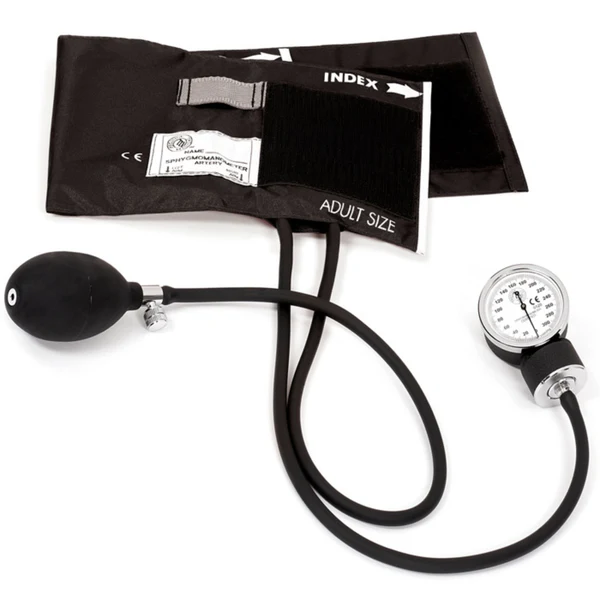
The aneroid sphygmomanometer from MedTechKits remains a cornerstone of diagnostic medicine, relying on mechanical precision rather than digital algorithms.
This device consists of a pressurized cuff, a measurement gauge, and a controlled inflation system that work in perfect harmony to detect Korotkoff sounds.
Each part of the assembly is designed to provide tactile feedback and visual clarity during the stressful environment of a clinical rotation.
The seamless integration of the bulb, valve, and manometer allows for a fluid workflow that digital units often fail to replicate.
Dense Nylon Cuff: Engineered for Rigorous Decontamination
The outer sleeve of this sphygmomanometer is constructed from dense nylon, a material chosen for its exceptional durability and professional appearance.
This synthetic fabric is specifically engineered to resist staining and fluid absorption, which is vital when operating in unpredictable field conditions.
Beyond its protective qualities, the nylon architecture is designed to withstand the friction of repeated application without fraying or losing structural integrity.
Its smooth surface allows for rapid cleaning with medical-grade disinfectants between patient contacts, maintaining a high standard of hygiene.
Precision Sizing: Utilizing Index and Range Markings
The cuff surface features clearly printed index and range markings that serve as a visual safeguard against measurement errors.
These indicators allow the clinician to verify instantly if the adult-sized cuff, which fits a 10" to 16" circumference, is appropriate for the patient’s limb.
When the index line falls outside the designated range, the practitioner knows a different size is required to ensure a valid pressure reading.
The Artery Indicator: Ensuring Correct Anatomical Alignment
A prominent artery indicator is printed on the cuff to guide the practitioner in aligning the internal bladder with the patient's brachial artery.
Proper alignment is a technical necessity, as it ensures that the pressure is applied directly over the vessel being auscultated.
By following this visual guide, students can practice professional-grade accuracy in the classroom before moving on to complex cardiac scenarios with a lifepak simulator.
This helps the professional confidently position the equipment even in low-light or stressful environments.
The Manometer Gauge: Calibration Standards and Visual Clarity
The manometer serves as the brain of the instrument, utilizing a precision-calibrated needle to display pressure levels in millimeters of mercury.
Just as students use a 3d brain model to visualize the complex structures of the central nervous system, this gauge allows the clinician to visualize the internal pressure of the cardiovascular system.
Its high-contrast dial is designed for rapid legibility, featuring bold numbering and crisp incremental lines that are easy to track during deflation.
Reliability in the gauge is paramount, as every clinical decision rests on the accuracy of the needle’s movement across the face.
Ergonomic Inflation Bulb: Controlled Pressure Delivery
The inflation bulb is molded from a supple, latex-free material that offers a comfortable grip for users with varying hand sizes.
Its teardrop shape is designed to maximize air displacement with each squeeze, allowing the cuff to reach target pressure quickly and efficiently.
The responsiveness of the bulb allows the practitioner to feel the resistance of the air as the cuff expands against the arm.
Chrome-Plated Air Release Valve: Mastery of Deflation Rates
The chrome-plated brass valve provides the fine-tuned control necessary to achieve a steady deflation rate of 2-3 mmHg per second.
Its knurled thumb screw is designed for precision, allowing the user to make minute adjustments with a single finger.
A smooth valve operation ensures that the needle on the gauge drops consistently without jumping or stalling unexpectedly.
Standard Luer Connectors and Tubing Integrity
The system utilizes standard Luer connectors that ensure a secure, airtight link between the bulb, the tubing, and the internal bladder.
lThese connectors are designed for a universal fit, making it easy to replace individual parts or perform maintenance if needed.
High-quality tubing ensures that the pressure generated in the bulb is transmitted to the gauge and cuff without any loss of energy.
Frequently Asked Questions
Q1. How can I tell if my blood pressure gauge is no longer calibrated correctly?
A quick way to check is by looking at the needle when the cuff is fully deflated and disconnected. The needle should rest directly inside the small zero mark at the bottom of the gauge. If it sits outside that area, the readings may no longer be accurate and the device likely needs recalibration.
Q2. Why does the needle sometimes shake or bounce while I’m taking a reading?
A small amount of movement is actually normal and often means the gauge is sensitive enough to pick up pulse vibrations. If the bouncing becomes excessive, there could be debris in the valve or moisture trapped inside the tubing. Checking the airflow system and keeping the tubing dry usually helps solve the issue.
Q3. Is the nylon cuff safe for patients with sensitive skin or allergies?
Yes, the cuff material is latex-free and designed to reduce irritation during use. The smooth nylon surface is also less likely to trap allergens or moisture compared to older fabric styles. For patients with fragile or irritated skin, the cuff can sometimes be placed over a thin layer of clothing if needed.
Q4. What should I do if the air release valve starts feeling stiff or difficult to turn?
This usually happens when dust, lint, or debris builds up around the valve threads. In many cases, gently cleaning the area with a dry cloth will restore smoother movement. It is best to avoid using oils or heavy lubricants because they can attract more dirt over time.