Blockchain Technology and the Modernization of Intellectual Property Protection
IP protection is more critical than ever in the digital age. Intellectual property (IP) is the intellectual product; for example, invention, book, music, software, design, trademark and artwork. The ease of copying and distributing digital content without permission is increasing as technology continues to grow. This obstacle has spurred the development of blockchain as a new way to update the intellectual property protection system.
Blockchain is a digital system that securely and transparently stores information. If a piece of information is entered in a blockchain, it is very hard to alter or remove it. A blockchain's use in protecting intellectual property is of great value with this feature. Creators can register their work to a blockchain and get a permanent record that will show when the work was created and who owns it.
Proof of ownership is one of the greatest advantages of blockchain technology. Historically, inventors, songwriters, or artists had difficulty establishing their right to an invention, song, or artwork. In blockchain, each record has a time stamp that indicates the exact date and time of a creation. I think this can help to minimize arguments about ownership and ease the burden on creators to protect their rights.
Transparency is another key benefit. With blockchain, it is possible to trace the origin and evolution of an IP asset that has been created and handed over to an authorized user. Suppose a musician owns a song and wants to track its distribution, they can utilize blockchain to prove their ownership and track the song's propagation. This transparency fosters trust between creators, buyers, investors, and licensing companies.
Smart contracts are also enabled on Blockchain. Smart contracts are computer programs that automatically execute when specific conditions are fulfilled. As an example, when a songwriter signs a song on to a streaming platform, the smart agreement can immediately release royalties once the song is performed. This is very helpful, as it helps to cut down on delays, steer clear of human error and ensure creators are fairly compensated.
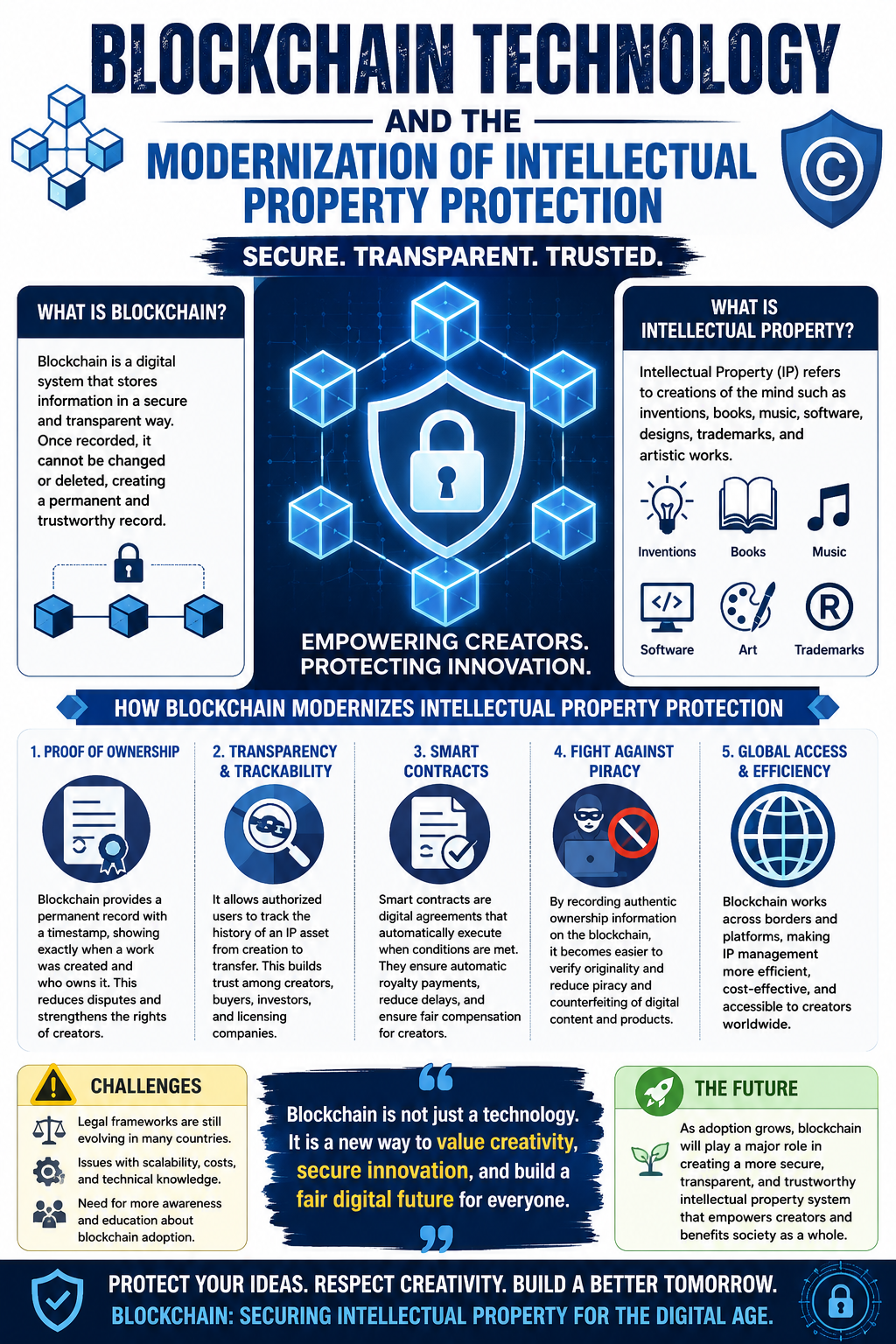
Moreover, blockchain can prevent piracy and prevent counterfeiting. The fraudulent sale of goods and the creation of pirated digital media products is significant and expensive on a global scale. The consumer or business can check if a piece of content or a product is genuine after buying it simply by logging in to the blockchain and seeing the original ownership details, which are verified by the blockchain.This verifies the original ownership information on a blockchain, so that the consumer or business can check whether the product or piece of content is genuine after purchasing.
Although blockchain technology has its benefits, it has its challenges. The legal frameworks for blockchain-based intellectual property protection and enforcement are not fully developed in some countries. Additionally, there are some concerns about scalability, costs, and technical knowledge needed to implement. But these difficulties are slowly being overcome with new advances in technology.
To conclude, blockchain has revolutionized the way IP is protected in today's digital age. It is also a great innovation for its security, transparency, proof of ownership, automation of royalty payments, and anti-piracy features. I feel that the more people are adopted, the more blockchain will shape a more efficient and trustworthy intellectual property system to serve creators of the world.