The Role of Artificial Intelligence in Enhancing Blockchain Security Systems
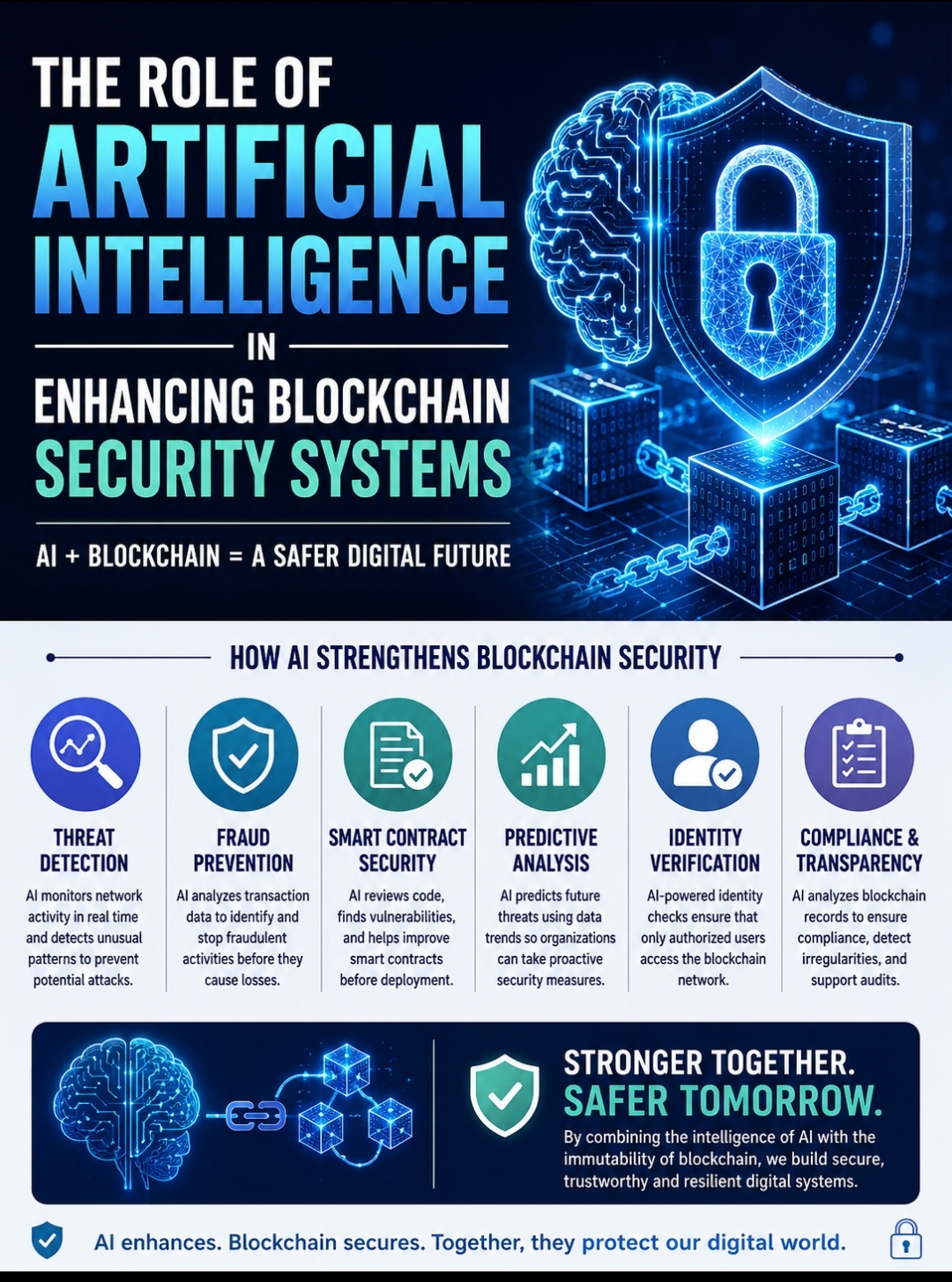
Two technologies that are playing a major role in the modern digital landscape are Artificial Intelligence (AI) and Blockchain. Both technologies are impacting the lives, work, and business of people. Artificial Intelligence is known for its ability to learn, analyze data, make smart decisions, while blockchain is known for providing secure and transparent records. These two technologies can be used together to make more robust and secure systems. With the rise of cyber threats worldwide, the role of Artificial Intelligence in blockchain security systems is increasingly gaining significance.
Blockchain is a digital system that stores information in blocks that are connected together in a chain. After putting information on the blockchain, it is quite challenging to alter or delete this information. This renders the blockchain extremely secure and trusted. It is widely adopted in various applications, including cryptocurrencies, financial services, supply chain, healthcare, and more. While blockchain systems offer robust security features, they can still be vulnerable to various threats, including hacking attempts, fraud, malware attacks, and suspicious transactions. This is where Artificial Intelligence proves to be very handy.
Blockchain systems are aided by Artificial Intelligence in continuously monitoring activities. AI can process vast amounts of information far quicker than humans. Can detect irregularities and suspicious activity before major harm is done. For instance, if an individual attempts to use an uncommon approach to a blockchain network, AI can identify the risk and notify the system administrators instantly. This helps in keeping away with security breaches and helps safeguard valuable information.
Another important role of AI in blockchain security is fraud detection. Digital asset fraudsters are getting bolder and more innovative in their methods. AI systems can analyze transaction logs to spot potentially suspicious activity. AI can be trained to recognize fraudulent transactions with a high degree of precision, thanks to its ability to learn from previous data. This enables organisations to prevent the loss of any major quantity due to fraud. This is, I think, one of the best things about bringing together AI and blockchain: it fosters trust among users.
Artificial Intelligence also improves the speed of threat detection. Most security systems are dependent on human security experts to detect and react to attacks. This can take time, and often, damage has already been done when action is taken. AI operates in real time and is capable of reacting to potential threats instantly. It automatically blocks harmful activities, isolates infected systems and minimises the effects of cyberattacks. This increases the robustness and reliability of blockchain networks.
Moreover, AI can enhance the security of smart contracts. Smart contracts are computer programs that are recorded on a blockchain and are self-executing if specific conditions are fulfilled. Smart contracts can be beneficial, but may have coding mistakes or vulnerabilities that hackers can exploit. AI can scrutinize smart contract codes for vulnerabilities and make recommendations for their improvement prior to deployment. This lowers the danger of security lapses and monetary loss.
Another aspect in which AI helps blockchain security is predictive analysis. Artificial Intelligence can study trends and predict possible future threats. Organizations can proactively take preventative measures based on AI-generated predictions, rather than waiting for attacks to occur. This proactive strategy enables businesses to be one step ahead of the cybercriminals. I'm fascinated by that aspect as prevention can sometimes be both better and cheaper than the repercussions of an attack.
AI can be utilized to enhance identity verification in blockchain systems too. Charges for blockchain platforms are required to verify their identities. Sensitive data can only be accessed by authorized users thanks to AI-powered facial recognition, fingerprint analysis, and behavioral monitoring. This makes blockchain systems even more secure as it minimizes identity theft and unauthorized access.
Furthermore, the combination of AI and blockchain promotes transparency and accountability. Blockchain stores the transaction data permanently while AI can review the data to monitor compliance and identify anomalies. This pairing can be applied in an organization to enhance audits, regulatory compliance and operational efficiency. This results in higher trust of users, customers and investors.
There are some difficulties, however, in light of these benefits. Combining AI and blockchain is difficult and costly to implement. There are required to be power computing resources, skilled professionals, and big investments in the organization. Data privacy and the ethical application of Artificial Intelligence are also issues that are on the mind. Hence, appropriate rules and good practices must be established and followed to make the most of the benefits and to reduce risks.
In conclusion, Artificial Intelligence plays a significant role in enhancing blockchain security systems. AI enhances threat detection, fraud prevention, smart contract security, predictive analysis, identity verification, and overall network protection. The collaboration between AI and blockchain will keep growing in value as the threats in the cyber space continue to grow. The successful integration of these two powerful technologies will play a significant role in the security of the future of digital. Together, Artificial Intelligence and blockchain can revolutionize digital environments for people and organizations globally, making them safer, smarter, and more trustworthy.
https://x.com/i/status/2038990196453126632
https://coinmarketcap.com/currencies/pussfi
https://x.com/i/status/2036134193260802100
Note:-
Regards, @adeljose