Cryptocurrency as a Hedge Against Inflation in Developing Economie
s
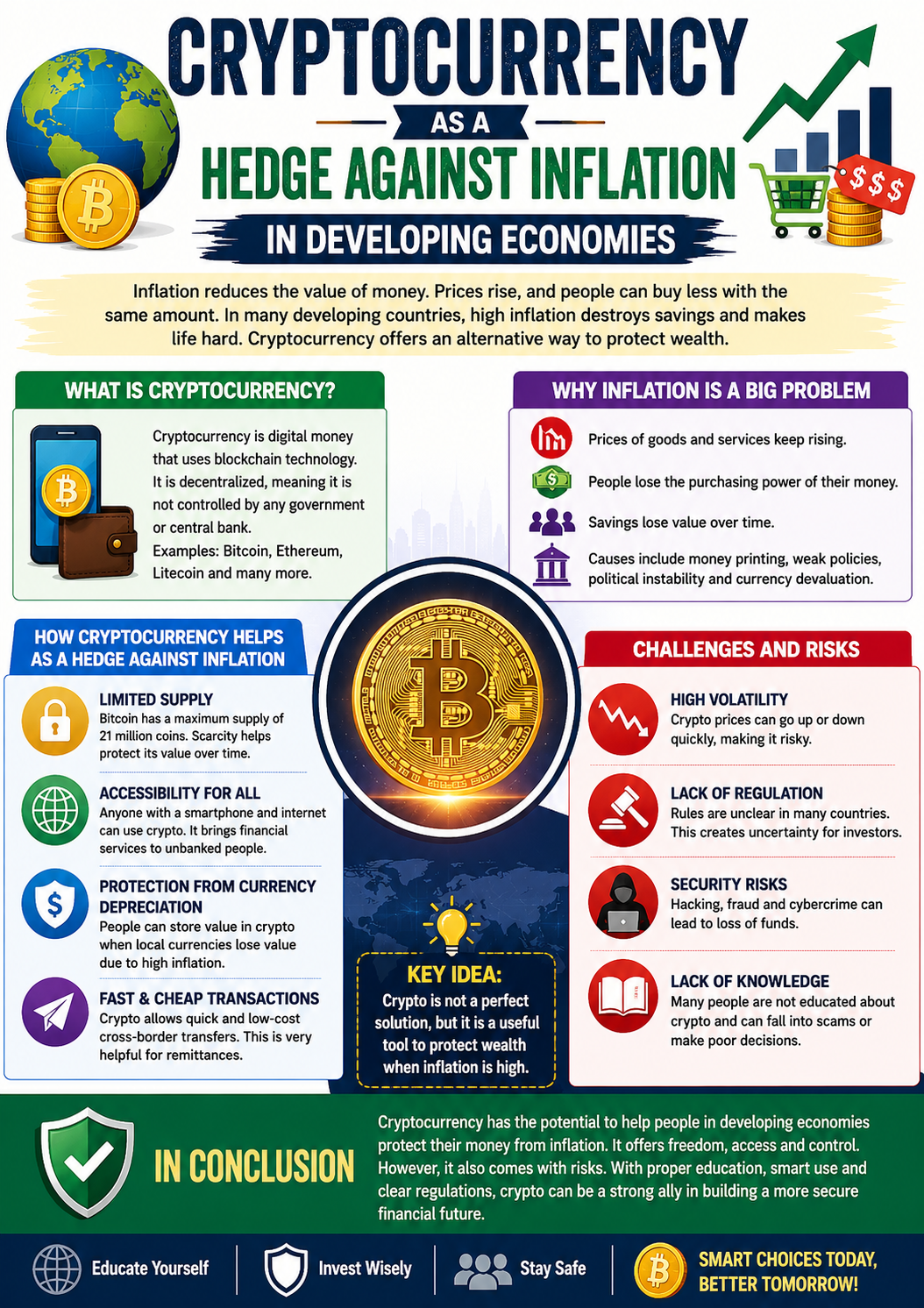
One of the greatest economic challenges being encountered by many developing countries today is that of inflation. When the price of goods and services keeps going up over time, and this also decreases the buying power of money. If inflation starts to get extremely high, individuals cannot purchase as many items with their money. This kind of situation is applicable to people, families, businesses and even government. Therefore, many are seeking methods to beat inflation with their investments. In recent years, one of the solutions that has been noticed is cryptocurrency.
Cryptocurrency is a digital currency based on blockchain technology. Cryptocurrencies are decentralized, unlike traditional currencies which are controlled by central banks and governments. Some of the most popular cryptocurrencies are Bitcoin, Ethereum, and Litecoin. Government-unstoppable and in some instances limited in supply, many people think that cryptocurrencies, Bitcoin in particular, can be a hedge against inflation.
Inflation in developing economies can be attributed to excessive money printing, poor economic policy making, instability in the political climate, and changing foreign exchange rates. A nation's currency tends to depreciate in a state of high inflation. Under such circumstances, the public might lose faith in their local currency and may start looking for other means to save their money. One of these has become cryptocurrency.
The limited supply of cryptocurrency is one of the reasons why it is a hedge against inflation. For instance, bitcoin can have a total of 21 million coins. Once this limit is reached, the Block reward will be halved and no more Bitcoin can be mined. Bitcoin differs from traditional currencies, which can be churned out by the government in bulk, with its limited supply, which helps to preserve its worth over time. This is a characteristic many investors recognize as akin to gold, which historically has been used as a store of value in times of inflation.
One more benefit of cryptocurrency is that it is easily accessible. A significant portion of the population in many developing countries is deprived of traditional banking services. But people have the availability of using the smartphone and internet connection to reach the cryptocurrency wallets and trading platforms. This enables people to save, transfer and invest funds without relying on banks. This is, in my opinion, one of the reasons for the adoption and rise in popularity of cryptocurrencies within developing economies.
Cryptocurrencies also ensure that people can safeguard their savings against the depreciation of local currencies. In nations with very high inflation, citizens may exchange their currencies for other currencies, like the U.S. dollar. But it might be hard to get foreign currencies, because of government restrictions or limited supply. Cryptocurrency is another alternative as it can be acquired online and kept electronically. This provides individual choices over finances and minimises reliance on volatile local currencies.
Moreover, cryptocurrencies allow cross-border transactions to be made. Remittances made by citizens abroad are an important source of funding for many developing countries. The process of traditional money transfer services can be costly and time-consuming. Funds can be transferred very quickly and frequently with cryptocurrencies at a comparatively lower cost. Such a benefit is especially significant when the economy is experiencing inflation, when each unit of value is significant to the household that is always trying to keep pace with inflation.
However, despite these benefits, cryptocurrency is not the ultimate answer to inflation. One big problem is that of its price volatility. Cryptocurrencies can experience significant price fluctuations over short periods of time. An example is Bitcoin, which could appreciate a lot one month and a huge percentage the next. The volatility introduces uncertainty and uncertainty arises the inability of some to use cryptocurrency as a stable store of value.
Another difficulty is the absence of regulations in certain countries. Governments continue to grapple with cryptocurrencies and how to regulate and monitor them. Some developing economies have unclear or frequently changing regulations. This may pose a danger to investors and hinder broader adoption. Furthermore, cryptocurrency exchanges can be susceptible to fraud, hacking, and cybercrime, leading to potential losses for investors.
Other barriers include lack of knowledge and digital literacy. In many developing countries, people aren't acquainted with the way cryptocurrencies function. People can be misinformed and make bad investments or fall victim to scams. Thus, a cryptocurrency to be a part of a meaningful solution in the fight against inflation, the public needs to be made aware and financial education must be imparted.
Considering the big picture, cryptocurrency has its pros and cons as a hedge against inflation. It has the advantages of protecting currency depreciation, financial inclusion, and people's currency value. However, its effectiveness is restricted by price volatility, regulatory uncertainty and security concerns. I believe that cryptocurrency is a complement to the various tools people have to safeguard wealth as opposed to a replacement for financial assets.
Finally, cryptocurrency is a possible means of protecting against inflation in developing economies. Because of limited supply, decentralized nature and accessibility, it is appealing to those in high inflation countries. It has a few advantages but also several potential hazards that cannot be disregarded. With evolving technology and increasingly clear regulations, cryptocurrencies can be expected to have an even more significant influence in the preservation of wealth and the creation of financial stability of individuals in developing economies.
https://x.com/i/status/2038990196453126632
https://coinmarketcap.com/currencies/pussfi
https://x.com/i/status/2036134193260802100