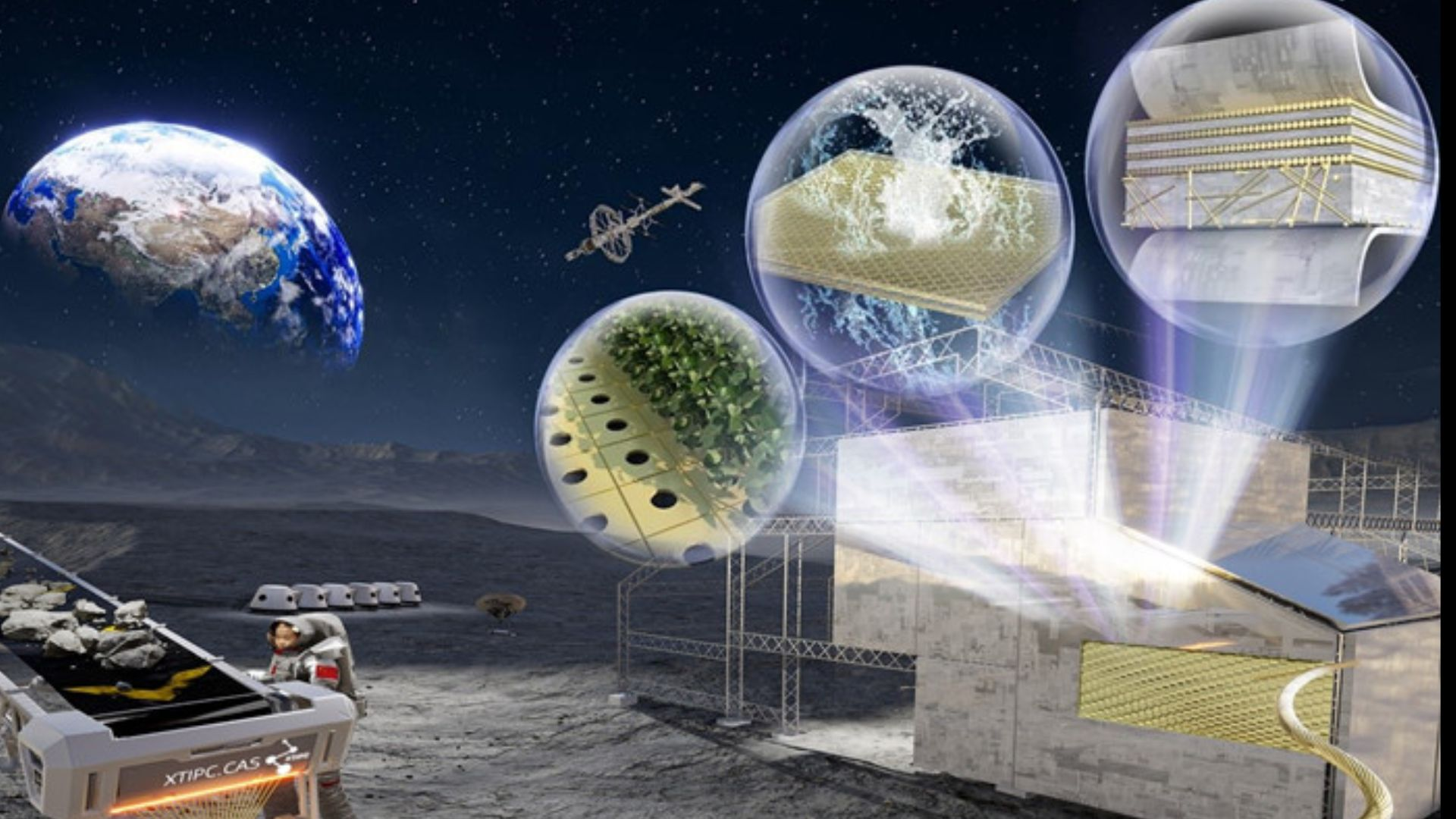
New materials for Lunar bases.

in Popular STEM2 days ago

New materials for Lunar bases.


Souce


How will the first human city on the Moon be built? Many of us have already imagined rockets transporting tons of steel, concrete and equipment from Earth to create permanent bases outside our planet, but there is a simple problem, each kilo sent to space costs a fortune and the more distant the mission the more unviable this strategy becomes, which is why scientists around the world have been pursuing a fascinating idea, building using the resources found on the Moon itself.


And China has just taken an important step in that direction, recently Chinese scientists sent experimental samples of fibers produced from lunar soil into space, the objective is to test how this material behaves directly exposed to the extreme conditions of the space environment, including radiation, brutal temperature variations and almost absolute vacuum.


The process begins with the overheating of the lunar regolith, the layer of dust and fragments that covers the surface of the moon. When this material is heated until it melts, it is transformed into small liquid drops. These drops go through a process of traction and rotation at high speed, similar to the principle used to make cotton candy, the difference is that instead of sugar we are talking about molten lunar rocks.


The result is ultra-fine, continuous and extremely resistant fibers, with a thickness comparable to that of a human hair. The most impressive thing is that the first tests used just half a gram of real lunar material brought by the Sheng 5 mission. Even with such a small amount, the researchers managed to produce a continuous fiber approximately 3 m long and this opens up enormous possibilities. These fibers can be woven to form flexible structures such as tents and habitation modules or they can be incorporated into the so-called lunar concrete.


In this scenario they would function like the steel bars used in terrestrial constructions, reinforcing walls, platforms and future permanent installations. The choice of this path is not random, the lunar soil has mineral characteristics similar to certain volcanic basalts found on Earth, materials already known for their mechanical resistance when transformed into fibers.


We are beginning to learn how to transform lunar dust into infrastructure and this may be one of the most important changes for the future of space exploration, because when a civilization learns to build using the resources of its own environment, it stops being a visitor and becomes an inhabitant. The big issue is that these fibers represent much more than a new construction material, it symbolizes the transition of humanity from a species that only visits other worlds to a species capable of living in them.


Study Source


The images without reference were created with AI
Thank you for visiting my blog. If you like posts about #science, #planet, #politics, #rights #crypto, #traveling and discovering secrets and beauties of the #universe, feel free to Follow me as these are the topics I write about the most. Have a wonderful day and stay on this great platform :) :)


! The truth will set us free and science is the one that is closest to the truth!


Sort:  

Congratulations!

Your post has been selected and upvoted by the SteemPro Team 🚀

Explore more on SteemPro:
🌐 https://www.steempro.com
🎮 Play SteemHeights: https://www.steempro.com/games/steem-heights
💬 Join our Discord: https://discord.gg/Bsf98vMg6U

💪 Supporting the growth of the Steem ecosystem together.

🟩 Vote for witness faisalamin:
https://steemitwallet.com/~witnesses
https://www.steempro.com/witnesses#faisalamin

steempro-cover-black.png
This is an automated message.