VOXEL WARS: The First Real-Time Blockchain Battlefield Where Outcomes Are Determined On Abey
The evolution of blockchain gaming has been marked by bold promises—true ownership, decentralized economies, and player-driven ecosystems. Yet, in practice, many so-called “Web3 games” fall short, relying heavily on centralized infrastructure while only placing assets on-chain. This gap between promise and reality is precisely where VOXEL WARS positions itself as a transformative force. VOXEL WARS is not just another blockchain-integrated game—it is designed as a fully on-chain metaverse battle game, where every action, decision, and outcome is executed directly on the blockchain. Built on the Abey blockchain, the project introduces a fundamentally different architecture: the blockchain itself becomes the game engine.
In this article I will provide more details information about VOXEL WARS. So keep reading....
What Is VOXEL WARS?
VOXEL WARS is a fully on-chain metaverse battle game deployed on the Abey blockchain, where every gameplay action is executed directly through smart contracts. Instead of using blockchain merely for asset ownership, VOXEL WARS transforms the blockchain itself into the core game engine. Every move, combat action, loot event, mining activity, and reward distribution is permanently recorded on-chain. This architecture positions VOXEL WARS as one of the most ambitious experiments in fully decentralized gaming. By eliminating centralized game servers and off-chain gameplay logic, the project aims to create a transparent, immutable, and player-owned gaming ecosystem powered entirely by blockchain technology.
VOXEL WARS is a tactical blockchain battle game built entirely on-chain using the Abey blockchain network. Unlike conventional Web3 games where only NFTs or tokens exist on-chain, VOXEL WARS stores gameplay state, progression, rewards, and interactions directly within smart contracts. The project emphasizes the concept of “100% on-chain gameplay,” meaning the blockchain acts as the authoritative source for all game data and logic. In VOXEL WARS, there are no centralized databases managing progression, no private servers handling combat calculations, and no off-chain systems determining rewards.
The Vision Behind VOXEL WARS
The vision behind VOXEL WARS is much bigger than simply creating another blockchain game. The project is trying to push the idea of a truly autonomous, fully on-chain gaming universe where the blockchain itself becomes the game engine instead of just a place to store NFTs or tokens. Most so-called Web3 games still operate like traditional games behind the scenes. Assets may live on-chain, but gameplay, combat calculations, progression systems, matchmaking, and rewards are usually handled on centralized servers. VOXEL WARS takes the opposite approach. According to the project’s architecture, every movement, attack, loot event, mining action, and reward distribution is executed directly through smart contracts on the Abey blockchain.
That design reflects the core vision: eliminating dependence on centralized infrastructure. The project repeatedly emphasizes the idea that “the blockchain is the game.” Instead of trusting a company-controlled backend, players interact with immutable on-chain logic that anyone can verify. Another major part of the vision is permanent digital ownership. In VOXEL WARS, Warrior NFTs are not meant to be static collectibles. The NFTs evolve as players progress, with kills, experience points, levels, and statistics stored directly on-chain. The idea is that even if the front-end website disappeared, player assets and progression would still exist on the blockchain itself. The project also tries to address problems that damaged earlier play-to-earn ecosystems. Many Web3 games suffered from runaway token inflation, bot farming, and economies dependent on constant new-player growth.
Technically, the vision depends heavily on the scalability of the Abey blockchain. Because every action becomes a blockchain transaction, the network needs high throughput and low latency to avoid making gameplay painfully slow. Abey promotes itself as a high-performance EVM-compatible Layer-1 chain capable of handling thousands of transactions per second, which is why VOXEL WARS positions itself there instead of on more congested networks. At a broader level, VOXEL WARS fits into the emerging “fully on-chain gaming” movement. These projects aim to create games that are persistent, permissionless, and community-owned rather than dependent on a publisher’s servers or policies.
That said, there’s also a practical challenge behind the vision. Fully on-chain games are technically ambitious but still experimental. Running every action through smart contracts can create scalability, cost, and gameplay-speed limitations that traditional games avoid. The long-term success of VOXEL WARS will likely depend on whether it can balance decentralization with actual fun gameplay — because blockchain architecture alone rarely keeps players engaged for years. Still, the project’s central vision is clear: a persistent metaverse war game where players truly own their assets, every action is transparently verifiable, and the game world can theoretically exist independently of any centralized operator.
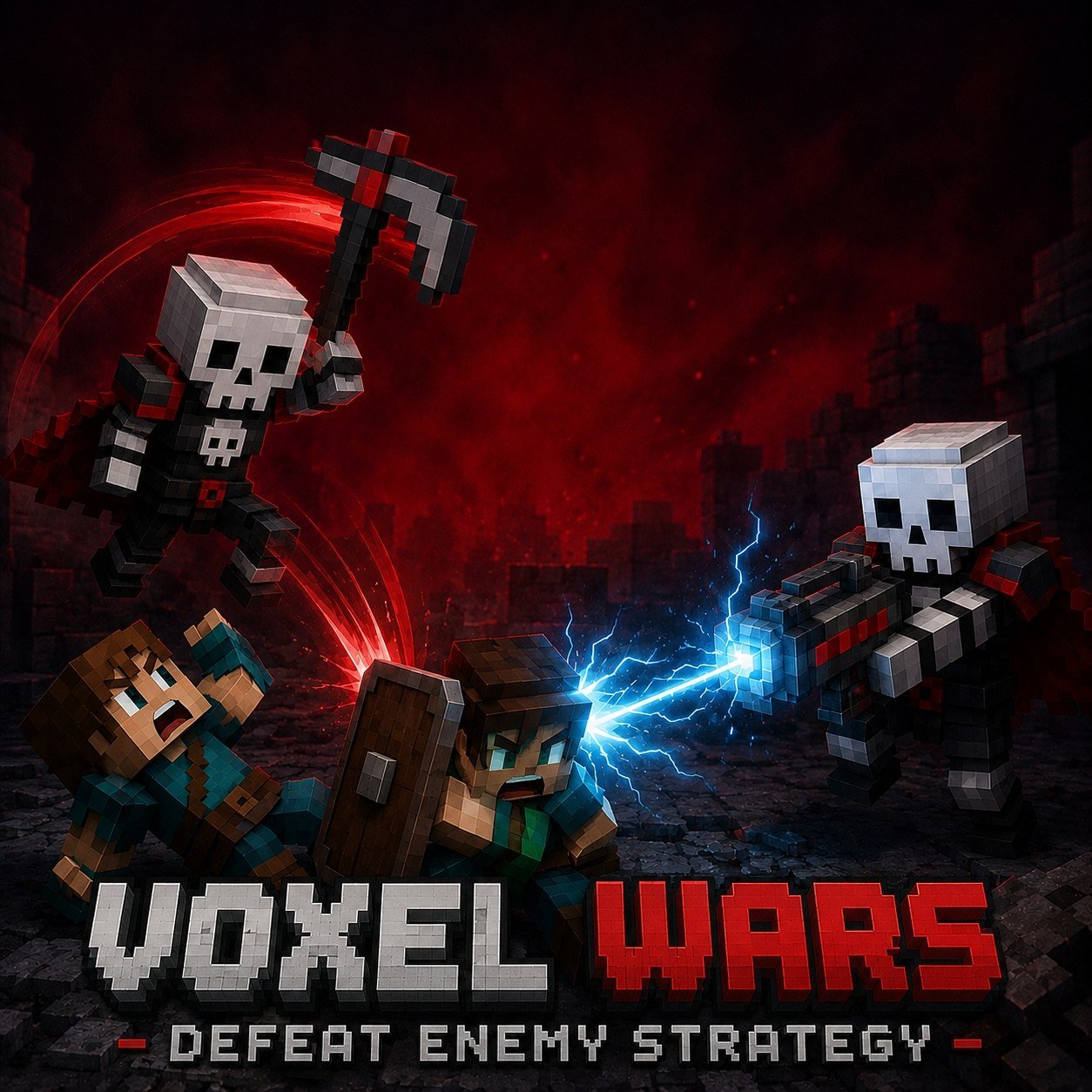
How Abey foundation makes VOXEL WARS possible
The relationship between VOXEL WARS and the Abey blockchain is central to the entire project. VOXEL WARS is not simply “hosted” on Abey — the game’s core identity depends on Abey’s infrastructure, performance model, and smart contract environment. VOXEL WARS describes itself as a fully on-chain metaverse battle game where every gameplay action is executed directly as a smart contract transaction on Abey. That includes movement, combat, loot collection, rewards, player progression, and NFT updates. Unlike most blockchain games that keep gameplay on centralized servers, VOXEL WARS attempts to use the blockchain itself as the game engine.
This design creates a heavy technical requirement. A normal blockchain like Ethereum mainnet would struggle if every player movement or combat action became an on-chain transaction. Gas fees and confirmation delays would make the game almost unusable. That is why the choice of Abey matters. According to the network’s documentation, Abey is an EVM-compatible Layer-1 blockchain focused on high throughput, low latency, and GameFi infrastructure. The network claims throughput reaching thousands of transactions per second with sub-second block times using a Delegated Proof-of-Stake architecture.
VOXEL WARS depends on those characteristics because the game continuously generates blockchain interactions. Every tile click, attack, chest opening, mining action, and portal use becomes a contract call recorded on-chain. The project frames this as a major difference from “fake on-chain” games where only NFTs or tokens are stored on-chain while the real gameplay still happens off-chain. The economic structure of VOXEL WARS is also tied directly to Abey’s transaction system. The project states that gameplay actions consume small amounts of ABEY gas fees, and part of those fees contribute to an automatic buyback-and-burn system for the VOXL token. The idea is that increased gameplay activity strengthens the in-game economy rather than merely creating inflation.
There is also a philosophical angle behind the partnership. Abey markets itself as infrastructure for GameFi, metaverse applications, and “inter-app” blockchain ecosystems where decentralized applications can interact with each other. VOXEL WARS fits neatly into that positioning because it tries to showcase what a fully autonomous blockchain-native game could look like. That said, fully on-chain gaming remains an experimental category. Many developers and blockchain communities argue that putting every gameplay action on-chain creates scalability and gameplay-speed challenges. Reddit discussions around fully on-chain games often point out that most successful Web3 games still rely on hybrid systems because pure on-chain execution can become slow, expensive, or mechanically limited.
VOXEL WARS essentially takes the opposite bet. Instead of balancing on-chain and off-chain systems, it tries to prove that modern blockchain infrastructure like Abey is now fast enough to support a persistent, transparent, fully decentralized gaming world.
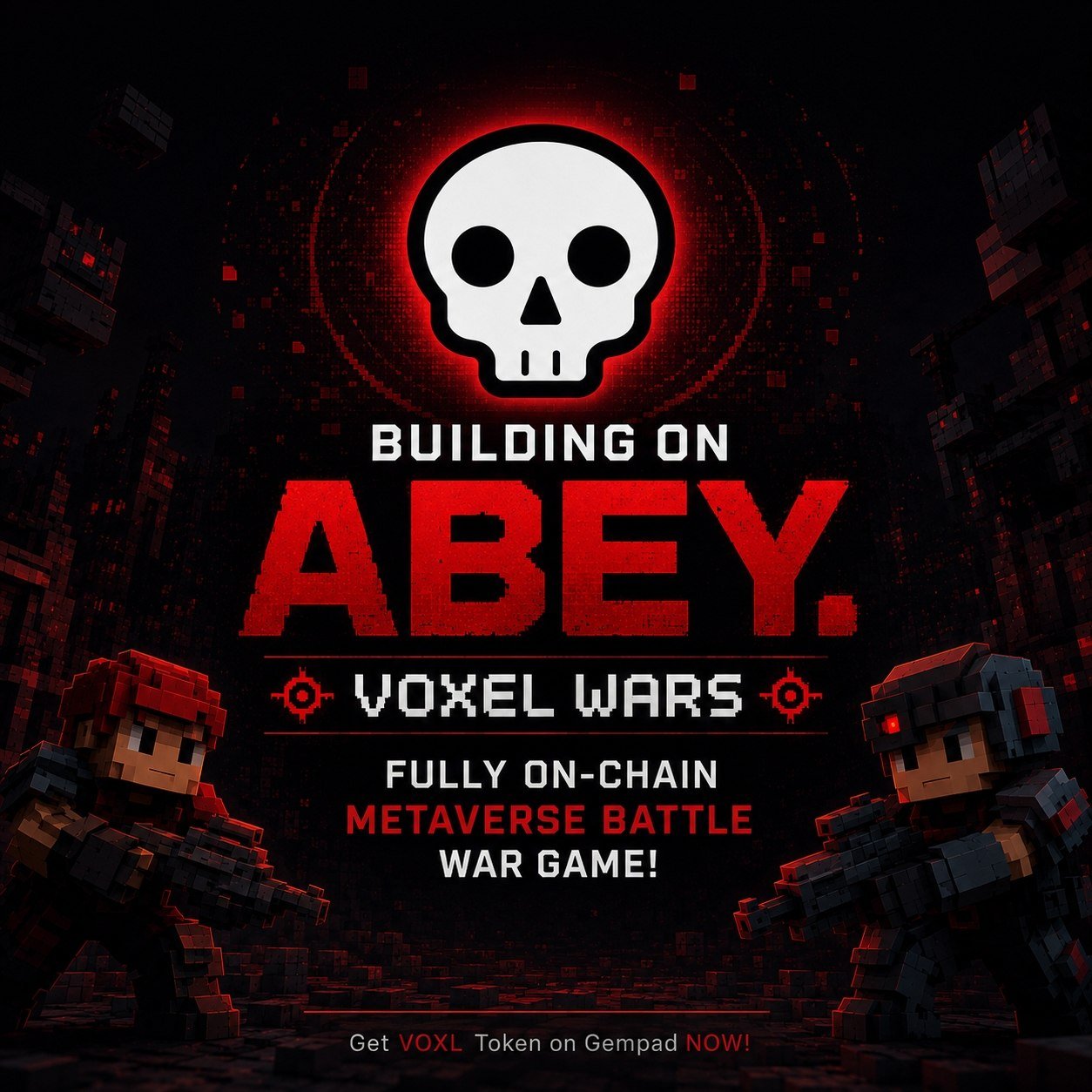
VOXEL WARS Gameplay Mechanics: Strategy Meets Blockchain
The gameplay mechanics of VOXEL WARS are built around an unusual idea: turning blockchain transactions into actual gameplay systems instead of using blockchain only for asset ownership. The result is a mix of tactical strategy, resource management, PvP competition, NFT progression, and on-chain economics. At the center of the game is a tactical 10×10 grid-based battlefield where players move Warrior NFTs across different tiles to explore, attack, mine, loot, and conquer territory. Unlike traditional strategy games where actions happen instantly on a centralized server, each move in VOXEL WARS is processed through a smart contract on the Abey blockchain. That changes how strategy works inside the game.
Every action has consequences because every action carries both opportunity and cost. Moving to a tile, attacking an enemy, opening a chest, mining resources, or using portals can generate VOXL token rewards, but actions also trigger token burn mechanics and gas fees. This creates a gameplay loop where players constantly balance risk, timing, and resource efficiency. The tactical layer comes from territory control and positioning. Since the battlefield operates as a deterministic on-chain environment, players must think carefully about movement paths, enemy positioning, and reward zones. Certain actions may expose a Warrior to attacks while others open opportunities for larger rewards or strategic control over areas of the map. The system resembles a lightweight strategy-RPG mixed with blockchain resource economics.
Combat itself is integrated directly into the blockchain logic. According to the project’s structure, defeating enemies can generate significantly larger VOXL rewards than simple movement or mining actions. Loot chests and conquest systems introduce another strategic layer because players must decide whether aggressive expansion is worth the transaction costs and exposure to rivals. The game also uses seasonal competition mechanics. VOXEL WARS runs in 7-day competitive cycles with leaderboards and automated prize pool distributions for top Warriors. That means strategy is not only about individual battles but also about long-term efficiency over an entire season. Players who optimize movement, combat frequency, resource extraction, and survival can climb rankings and receive larger rewards at season end.
Another important mechanic is on-chain persistence. Warrior NFTs are not static cosmetics. Their kills, levels, experience points, and progression are permanently stored on-chain. In theory, that means a player’s achievements become immutable blockchain history rather than temporary server-side data controlled by a publisher. One of the more interesting strategic elements is the anti-bot design philosophy. Many earlier play-to-earn games collapsed because automated farming systems overwhelmed their economies. VOXEL WARS tries to counter this using gas-cost friction and transaction-based gameplay. Because every action requires blockchain execution, mass bot activity becomes more expensive and theoretically less profitable.
The economy itself is tied directly into gameplay mechanics:
- Movement generates small rewards
- Combat generates larger rewards
- Mining produces resources
- Chests create high-risk/high-reward opportunities
- Conquest grants major payouts
- Actions simultaneously burn VOXL tokens
This creates a feedback loop where gameplay activity both distributes and removes tokens from circulation. The project presents this as an attempt to avoid the inflation problems that hurt earlier play-to-earn ecosystems. There’s also a philosophical distinction between VOXEL WARS and many other blockchain games. Most Web3 titles still keep actual gameplay off-chain because real-time mechanics can become too slow or expensive when every action hits the blockchain. Reddit discussions around blockchain gaming often point out that hybrid systems dominate for practical reasons.
VOXEL WARS deliberately goes the other direction. Its gameplay mechanics are designed around the blockchain itself:
- Smart contracts act as the game logic
- Transactions become gameplay actions
- NFTs become evolving player identities
- Tokenomics become part of the strategy layer
That makes the game less like a traditional MMO with crypto features and more like an experiment in “blockchain-native” game design. Whether that model becomes sustainable long term depends on two things that every GameFi project eventually faces: scalability and player retention. A technically impressive on-chain system still needs engaging gameplay depth to survive after the initial novelty fades. But as a concept, VOXEL WARS is trying something more ambitious than many standard play-to-earn games — merging tactical gameplay and blockchain infrastructure into a single unified system rather than treating crypto as an optional add-on.
VOXEL WARS Tokenomics
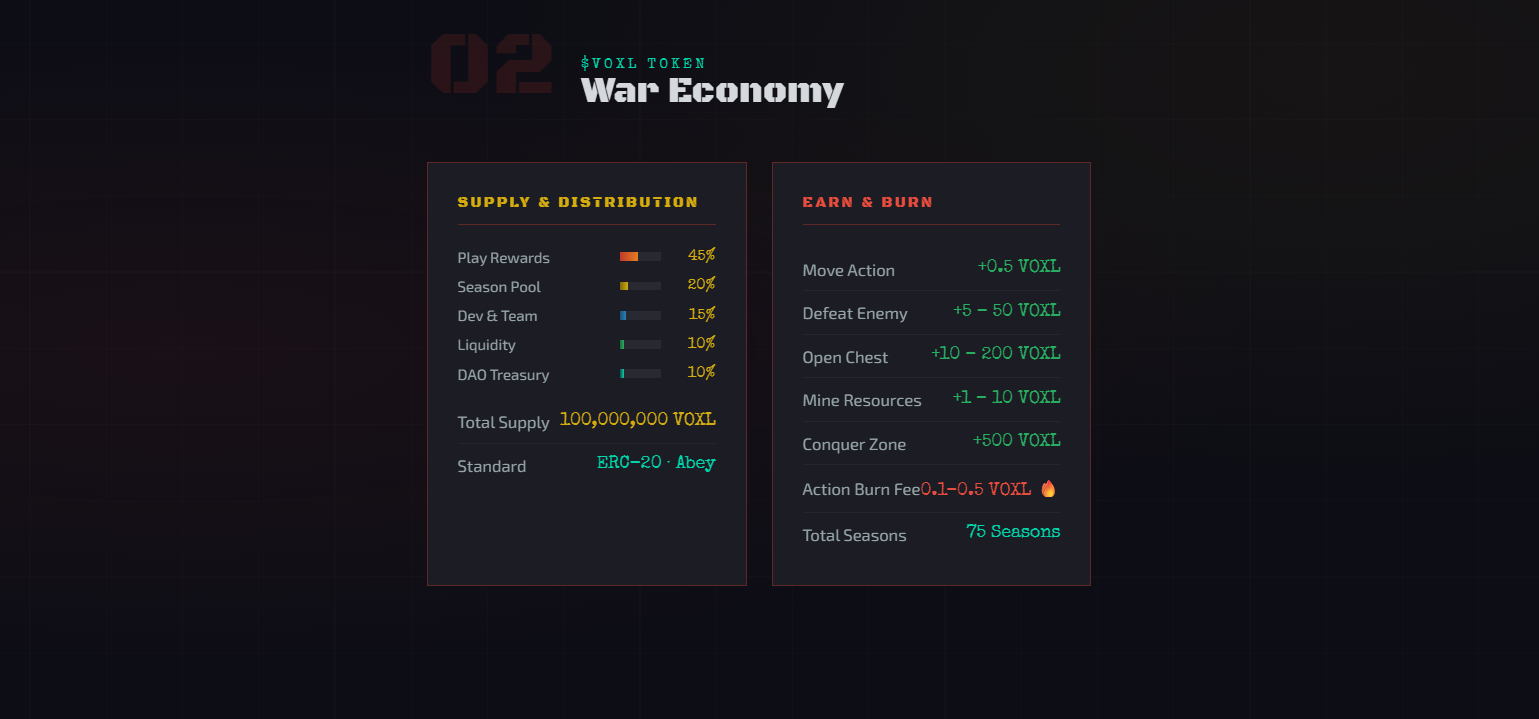
The VOXEL WARS ecosystem is powered by the VOXL token, designed as an ERC-20 asset with a fixed total supply of 100,000,000 tokens. The allocation structure reflects a balance between gameplay incentives, ecosystem sustainability, and long-term development.
According to the project’s framework, the token distribution is divided as follows:
- 45% allocated to play-to-earn rewards
- 20% reserved for seasonal competition pools
- 15% assigned to the development team
- 10% dedicated to liquidity provisioning
- 10% allocated to the DAO treasury
This distribution model aligns closely with the game’s core mechanics, particularly its emphasis on competitive seasonal gameplay and ongoing player rewards. However, detailed information regarding vesting schedules, lockups, or emission timelines is not explicitly outlined in the primary materials. At the gameplay level, VOXL is deeply integrated into player activity. Rewards are distributed based on in-game actions such as movement, combat, mining, and loot events, with varying reward ranges depending on the outcome and risk level. At the same time, each action incurs a burn fee ranging between 0.1 and 0.5 VOXL. This introduces a built-in deflationary mechanism, where increased gameplay activity directly reduces the circulating supply.
Beyond action-based burns, the system incorporates an additional deflationary layer through a buyback-and-burn model. Specifically, 5% of the ABEY gas fees generated by in-game transactions are used to purchase VOXL from the market and permanently remove it from circulation. This creates a feedback loop where higher network usage contributes to increased token scarcity. Another important sink mechanism is tied to NFT creation. Minting a Warrior NFT requires burning 10 VOXL, effectively linking player onboarding and asset expansion to token supply reduction. Combined with action-based fees, this ensures that both entry and ongoing gameplay contribute to deflationary pressure.
Taken together, these mechanics create a token economy where rewards and burns are tightly interwoven. Players earn VOXL through participation, but they also continuously spend and burn tokens to interact with the game. This dual-flow structure is intended to counterbalance the inflationary issues that affected earlier play-to-earn models. That said, the net token flow remains an important consideration. While individual actions may yield rewards greater than their associated burn costs, the overall balance across the ecosystem—especially during periods of high activity—depends on aggregate behavior. Key metrics such as total burn volume, buyback execution, and emission rates are not fully detailed in the available materials and would require direct on-chain analysis for verification.
In essence, VOXEL WARS positions its tokenomics as a more sustainable alternative to traditional GameFi models, combining continuous reward distribution with multiple deflationary mechanisms. Whether this balance holds over time will ultimately depend on real player activity, economic tuning, and long-term ecosystem growth.
Conclusion
VOXEL WARS represents a bold step forward in blockchain gaming, challenging conventional models with a fully on-chain architecture. By eliminating centralized servers and placing all gameplay logic on the blockchain, it delivers a level of transparency, permanence, and ownership rarely seen in the gaming industry. Its combination of tactical gameplay, NFT-based progression, and deflationary tokenomics creates a unique ecosystem where players are not just participants but integral components of the game’s economy. While challenges remain—particularly around scalability and user experience—the project’s design offers a compelling vision of what the future of Web3 gaming could look like.
For more details
- Website: https://voxelwars.xyz/
- Twitter: https://x.com/voxelwarsgame
- Telegram: https://t.me/voxelwars
Author:
BTT username: Coen_Wren
BTT Profile Link: https://bitcointalk.org/index.php?action=profile;u=3696559
Bep-20 address: 0xe6bB82E9329c9b15BaAe497a82071D673a2a59c6