Do Home Batteries Really Need All That Monitoring?
When most people think about home batteries, they still picture a physical object:
a box that stores electricity during the day and releases it at night.
But in real-world operation, especially with modern LiFePO₄ systems, this description is incomplete.
A home battery is no longer just hardware.
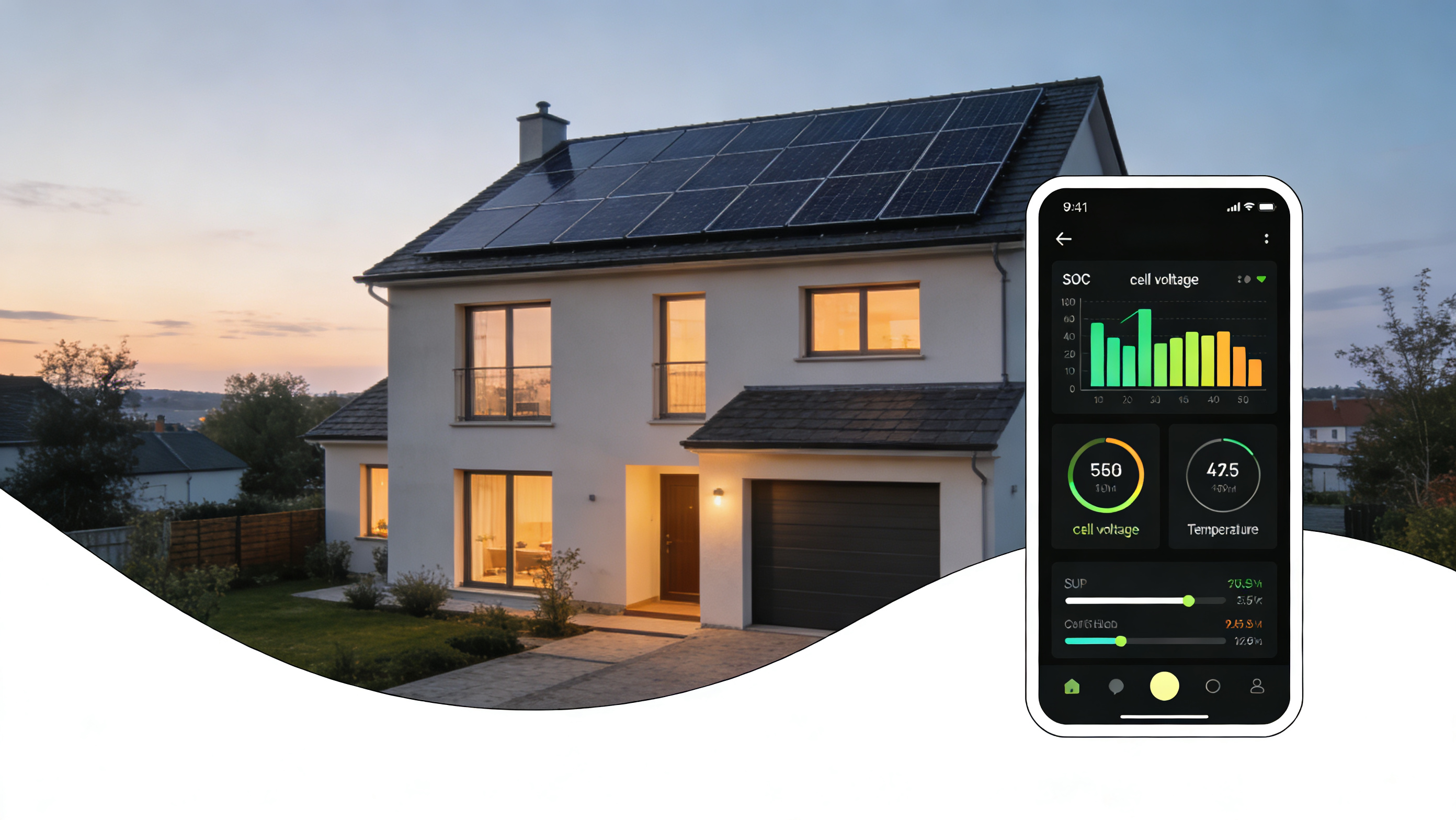
It behaves more like a continuous data system.
The Misleading Idea of “Just Storage”
The traditional way to describe batteries is simple:
Energy goes in. Energy goes out.
This works in theory, but it ignores what actually happens inside the system.
A real battery system is constantly:
- Measuring voltage across individual cells
- Tracking charge and discharge flow
- Adjusting behavior based on temperature
- Logging historical performance patterns
Even when you are not actively interacting with it, data is always being generated.
Why Data Matters More Than Static Capacity
Two batteries with identical capacity can behave very differently over time.
Not because of the hardware alone, but because of how the system interprets internal data.
For example:
- One system detects imbalance early and adjusts charging behavior
- Another system ignores subtle drift until it becomes a problem
The result is not a sudden failure, but a gradual difference in usable performance.
In practice, data handling affects real-world energy availability more than nominal specifications do.
A Simple Way to Understand It
Think of it this way:
- Hardware = potential energy storage
- Data system = how that energy is managed over time
Without data, the system is static.
With data, the system becomes adaptive.
This is why modern Battery Management Systems (BMS) are not just protection circuits anymore. They are continuous monitoring and decision layers.
What Changes in Real Use
Once a battery behaves like a data system, several things become noticeable:
1. Performance Becomes Dynamic
The system adjusts behavior based on past cycles, not just current state.
2. Problems Appear as Trends, Not Failures
Issues like imbalance or resistance increase slowly instead of suddenly.
3. Efficiency Depends on Interpretation
How well the system uses data directly affects usable capacity.
Why This Shift Is Important for Home Energy
In residential setups, energy systems are no longer isolated.
They interact with:
- Solar generation
- Household consumption patterns
- Weather variability
- Sometimes even grid pricing
This makes real-time interpretation of data more important than raw storage size.
A larger battery without good data handling can perform worse than a smaller but smarter system.
A Personal Observation
What changed my understanding was realizing that most “battery issues” are not hardware failures.
They are visibility problems.
When you cannot see what is happening inside the system over time, everything looks like randomness.
When you can see the data, patterns become obvious.
Closing Thought
Home energy storage is often discussed as an energy problem.
But in practice, it is equally a data interpretation problem.
Modern systems built around smart BMS architectures—such as those used in LiFePO₄ storage solutions from :contentReference[oaicite:0]{index=0}—reflect this shift toward continuous monitoring and system-level awareness.
For a deeper technical breakdown of how monitoring, SOC estimation, and system communication work together, this guide provides a structured overview