Transparent Account Suspension Policy — When and Why Crypto Card Accounts Get Suspended
The question most users never ask before signing up: what actually causes an account suspension?
Among the questions users rarely ask before signing up for a fintech product is the one that matters most when something goes wrong: under what circumstances will the operator suspend or close my account? The information is usually available — buried in Terms and Conditions documents that most users do not read — but it is rarely surfaced clearly in marketing materials. The asymmetry produces a predictable pattern: users sign up expecting unlimited access, encounter a suspension event, and feel ambushed by terms they technically agreed to. The alternative — operators that publish suspension criteria transparently — produces better-informed users and fewer disputes. BeeXpay's documented policy is worth examining as a reference.
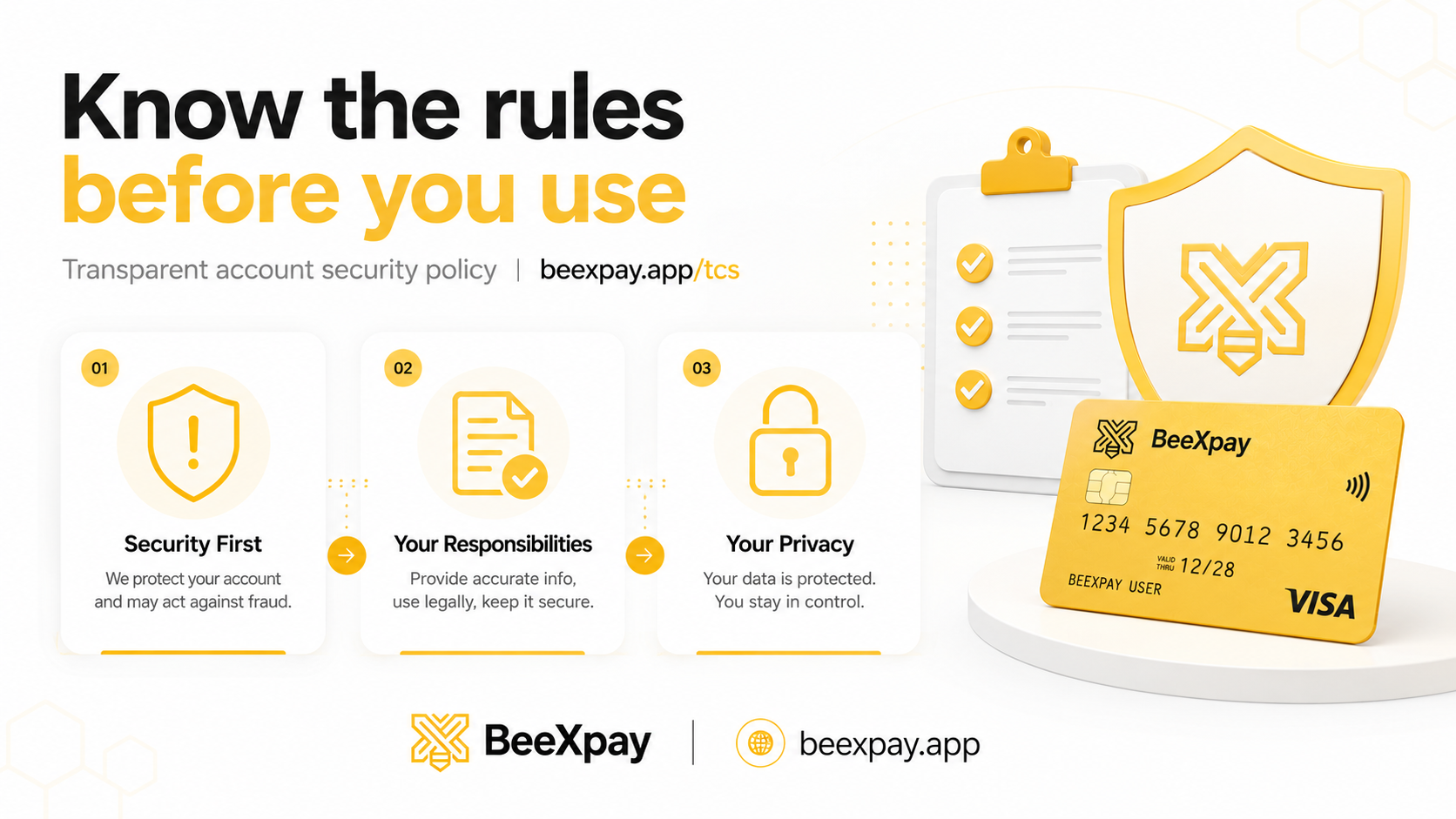
The 3 main reasons cards get suspended:
BeeXpay's TCS identifies three primary categories of account suspension. First: suspected fraud. The platform's AI fraud detection and real-time monitoring may flag transactions or patterns that warrant suspension while investigation proceeds. Second: violation of TCS. The Terms and Conditions of Service specify the user obligations — accurate information at registration, no reselling of services, protection of credentials, legal personal use only. Violation of these obligations is grounds for suspension. Third: request from competent authorities. Legitimate requests from regulatory or law enforcement authorities may require BeeXpay to suspend accounts as part of broader compliance actions. The three categories cover the spectrum of routine, user-side, and external triggers.
What fraud detection looks like in practice
The "suspected fraud" category covers a range of patterns the AI fraud detection system may flag. Unusual geographic patterns (transactions from countries inconsistent with the user's historical pattern). Unusual amount patterns (sudden large transactions for a low-volume account, or vice versa). Suspicious merchant categories (high-risk merchant categories that match known fraud patterns). Velocity patterns (high transaction frequency in short windows). Device patterns (login from devices inconsistent with the user's pattern). The detection runs in real-time, and most flagged transactions are handled at the transaction level (decline or hold) rather than account-level suspension. Account suspension applies to patterns severe or repeated enough to warrant fuller investigation.
How territory restrictions affect account status
Territory restrictions are a structural compliance layer that affects account standing independently of user behavior. BeeXpay services are unavailable in the United States, United Kingdom, Russia, Iran, North Korea, Afghanistan, Syria, Cuba, Libya, Somalia, Sudan, and Crimea. Accounts created from restricted territories — or that move into restricted territories — may be suspended without notice per the TCS. The restrictions follow regulatory requirements rather than commercial choice. Users planning travel through restricted jurisdictions should understand that maintaining account standing requires not using the account from those locations. The policy is explicit rather than discretionary.
Client obligations that protect account standing
The TCS specifies user obligations that, when followed, keep accounts in good standing. Provide accurate information at registration — false or misleading registration data is a TCS violation. Do not resell BeeXpay services to third parties — the account is for personal use. Protect login credentials — credentials shared or compromised place the account at risk and may be treated as user negligence. Use the account for legal personal purposes only — the platform is not intended for business resale of services or for unlawful activity. Notify BeeXpay of unauthorized access promptly. Each obligation is documented; following them reduces the risk of TCS-based suspension to operational accidents rather than substantive issues.
What to do if you believe a suspension was an error
If an account is suspended in error, the path forward is procedural. The user contacts BeeXpay through the published support channel (typically [email protected] or the in-app support function). The communication should specify the issue, the account information sufficient to identify the account, and any context supporting the user's claim that the suspension was an error. The platform reviews the case. Resolution depends on the underlying cause — if a fraud flag was a false positive, lifting the suspension is straightforward; if the suspension followed a TCS violation, lifting may require remediation of the underlying issue. The TCS does not guarantee automatic reinstatement, but it does not foreclose remediation either.
Closing CTA
Explore payment access → https://beexpay.app