Cross-Border Payments Without a Bank Account — Receiving Crypto and Spending It Directly via a BeeXpay Card
For people without bank accounts, crypto was supposed to change financial access — the missing piece was a usable card.
The financial inclusion promise of crypto has been discussed for over a decade. The argument: digital money that lives on permissionless networks could give the world's unbanked population access to financial services they had been denied by traditional infrastructure. The promise was partial. People could hold crypto without a bank, true. They could send and receive across borders without a bank, true. But spending that crypto on rent, food, utilities, and the rest of daily life still required converting it to local currency through a banking system many of them could not access. The card layer was the missing piece. Crypto-funded cards that do not require a bank account to issue close that specific gap.
The bank account barrier in crypto spending
Traditional payment cards are issued by banks. The card itself is a credential that ties back to a bank account that holds the actual money. To get a card, the user must have a bank account. To have a bank account, the user must satisfy the bank's account-opening requirements — proof of address, employment or income verification, sometimes minimum deposit, often in-person identity verification, and increasingly tight checks against sanctions and politically-exposed-person lists. For an unbanked user, these requirements are exactly the barriers that excluded them from banking in the first place. A "crypto card" issued through a bank-linked model does not change this structure.
How crypto cards enable payment without banking
A crypto-funded card structurally differs from a bank-issued card. The card is not linked to a bank account; it is linked to a crypto balance held by the card issuer. The user funds the card with crypto from their wallet. The issuer converts the crypto to fiat at the moment of merchant payment in roughly five seconds. The merchant sees a standard card transaction. There is no bank account involved in the user's chain. BeeXpay implements this model: virtual card $10 or physical card $100, funded with BTC, ETH, USDT, or other supported cryptocurrencies, with USD transactions at $0.25–$0.50 flat and non-USD at 1.5–2% bank rate.
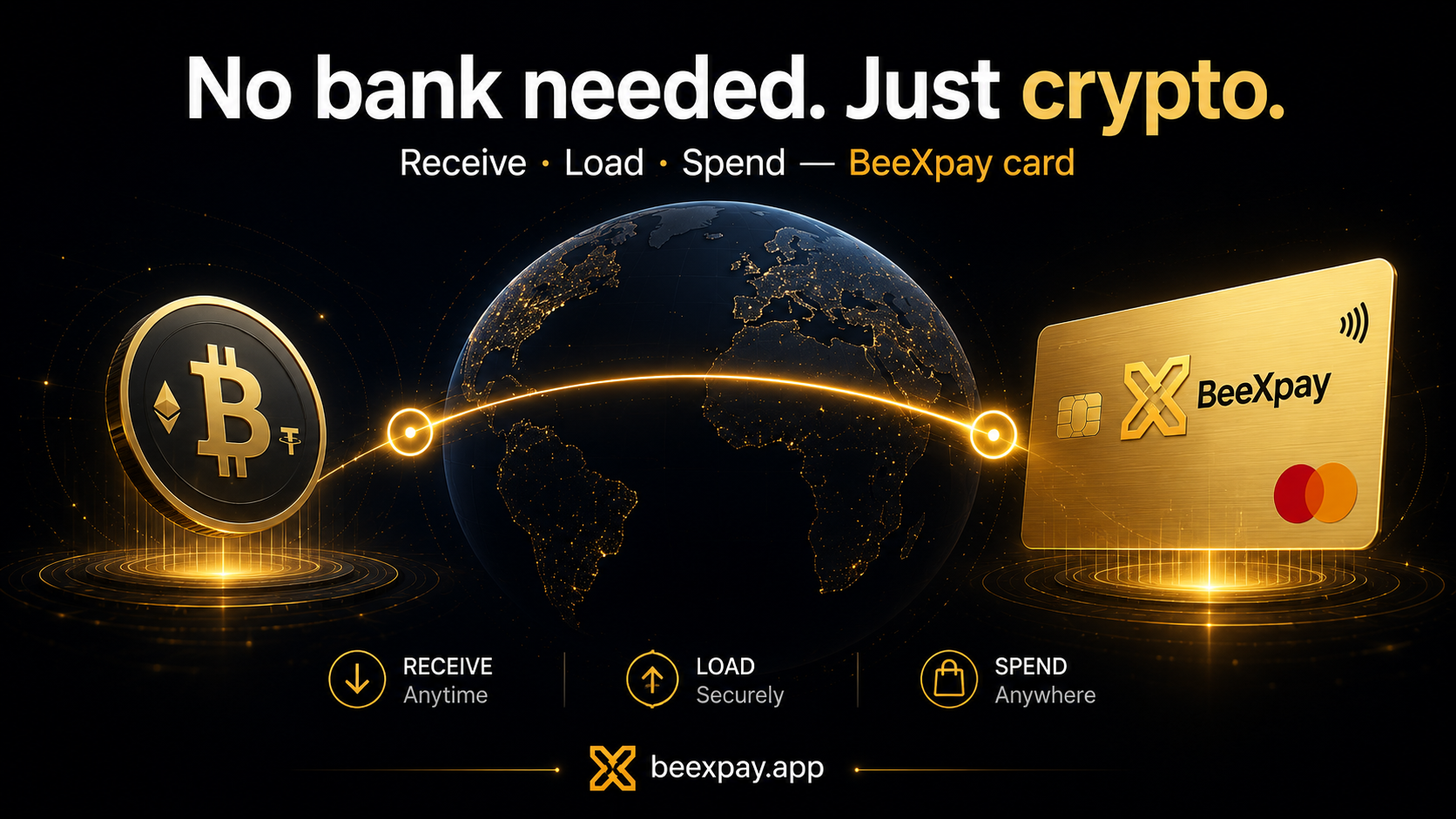
The mechanics: receive crypto → load card → spend
The flow has three steps. Receive crypto: the user receives a payment in crypto from any source — freelance work, remittance from family abroad, sale of goods, DAO compensation, Web3 employment. The crypto lands in the user's wallet. Load card: the user sends crypto from their wallet to the BeeXpay funding address. Once blockchain confirmation clears (varies by network), the card balance updates. Spend: the user uses the card at online merchants (and, for physical card holders, in-store) for everyday purchases — groceries, utilities, transit, subscriptions, anything that accepts standard card payments. The bank layer is absent from every step.
Real cost breakdown for $300/month spending without a bank
A user receiving $300/month in crypto and spending it through BeeXpay Light KYC: reload fee 4% on $300 = $12, transaction fees on ten USD purchases at $0.50 = $5, total $17/month to spend $300 of crypto income. Under Full KYC: 2.5% reload = $7.50, transaction fees $5, total $12.50/month. For non-USD purchases (depending on local currency), the 1.5–2% bank rate adds. The model is documented and reviewable. Compared to traditional remittance corridors (which often charge 5–10% on cross-border transfers), the card-route economics are competitive even before considering the time and accessibility advantages.
Limitations users must know (restrictions, KYC, reload fees)
Honesty about limitations matters. Territory restrictions apply: BeeXpay services are unavailable in the United States, United Kingdom, Russia, Iran, North Korea, Afghanistan, Syria, Cuba, Libya, Somalia, Sudan, and Crimea. KYC is required at some level — Light KYC for virtual cards (basic identification) or Full KYC for physical cards (full document verification). The reload fees are real costs that compound with monthly volume; they are competitive but not free. The crypto-to-fiat conversion uses market rates at moment of payment, which means the user's effective spending power tracks crypto price movements. The model is not anonymity; it is structural independence from banking, which is a different and more limited claim.
Closing CTA
Start using BeeXpay → https://beexpay.app