Karr
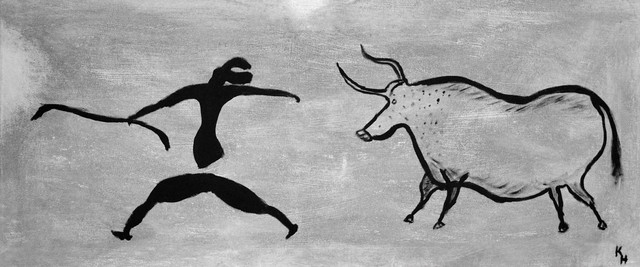
Karr grew up in a cave with a head full of voices, surrounded by voices and noises that were never his own. Although the tribe lived in each other's pockets, he always felt a distance. He spoke little, listened much, and watched animals longer than he watched people. The others thought him a strange bird. They said he was too soft, that he would never become a real hunter. Karr knew they were right. He felt no pride in killing, only an emptiness he could not explain.
When he was still young, he had found a wounded bull on the plain. The animal was enormous and clearly exhausted. Karr wanted to help, but the bull did not seem to understand him. It snorted and blew whenever he tried to come closer. In his dreams, Karr constantly had to run for his life. From the very first dream, the bull seemed to find him everywhere: by the river, among the rocks, on open plains where there was no shelter. For years Karr ran from him, for dreams were prophetic after all. That was what the cavemen had always said. Dreams are warnings you had better not ignore.
But he did not run out of fear or because he was afraid of pain; he ran because he did not know how to make the animal understand that he was not an enemy. Of course the tribe did not believe him when, after months, he tried to explain that he encountered the same bull everywhere. They grumbled that he was chasing shadows. But he knew better. The bull was real. And he ran and ran and was always alone, not only in his dreams but also in reality. Only those deafening voices in his head were always present.
One morning, when he was walking alone through the valley, he saw a lump of red earth at the foot of a hill. Ochre. He had seen it at rituals in which he was never allowed to take part. When he rubbed it with his thumb, his skin turned warm red. He took it back to the cave, ground it to powder and mixed it with some spit. It became a thick red paste. It went well with the piece of charcoal he had kept. If no one wanted or could understand what he meant, then he would just draw it. Drawings do not lie; they were sacred to the tribe. Messages and wisdom from their ancestors.
He drew the great bull and in front of it himself, small, looking behind him, running. Not as a hero. Not as a hunter. But as someone trying to escape, or who knows, to lure the bull to a better world. One where animals are not hunted. He did not expect anyone to understand it, but it was his truth.
The others laughed when they discovered the drawing. "Even on the wall that crazy Karr is scared," they roared. Karr said nothing. He knew there were no words that would change anything.
Many seasons later, the bull stood before him again, but this time the animal was old. Its eyes were dull. Karr stopped. He no longer ran; he too had grown older. Slowly he stepped forward and placed his hand on the rough fur. The bull sank to its knees and lay down. Karr stayed with him until long after the sun set. When the herd came to see, they formed a circle around them. They did not leave their side. For the first time he felt no distance. No judgement. Only togetherness.
When the tribe went hunting and saw him, he was standing among the bison. The old bull lay peacefully beside him. The herd stood still, as if Karr had become one of them. The hunters looked at him, at the herd, and at the dead bull. And for the first time they understood the drawing in the cave. Karr had not run from the bull for years because he was afraid. He had waited until the animal trusted him. Finally he had found his home and would lead them. From now on, the tribe would have to hunt for something else than Karr's herd.
17-4-2026
Picture: pixabay.com
See @wakucat for the picture prompt - #pic1000
You give the story a different and, in my opinion, very enjoyable approach. I approached it differently, but I liked reading your story. You make me get involved in the reading and imagine the events, and you achieve that too.
That is a sweet thing to say. I hope you like reading. At times it is good to relax, to put the mind of. Karr's head is most likely as busy as mine. The fact he knows the others laugh about him doesn't stop him from being different and living his life. And look, it all turns out wonder well. No need to join the cavemen group. At times being one of the cattle is a way better choice.
❤️🍀
I'm loving this history and how Karr understood something that so many people wants to understand.
Karr takes the time to observe and takes the time to think.
Thank you for your support. Karr and I are happy with it.
I wish you a great day!
People often misunderstood and even laughed at others. Turn out they are the biggest idiot of all.
With a lack of brain laughing or bragging is all there's left to keep up appearances...
And now you know why it is they call dumb behaving people with a lack of brain (intelligence) cavemen.
😉
The fool doth think he is wise