Blockchain Technology in Educational Credential Verification and Academic Integrity
One of the greatest part of human development is education. It provides opportunities for individuals to acquire knowledge, skills and qualifications which may enhance their lives and careers. But in today's world there are numerous challenges that the education institutions are having in the world. Academic Integrity and verification of academic credentials are two major issues of concern. Academic dishonesty, fake certificates and forged transcripts are important issues. In recent years, blockchain technology has proven to be a potential solution to these issues. The blockchain technology has the potential to enhance the security, transparency, and trustworthiness of educational data for schools, colleges, universities, employers, and students.
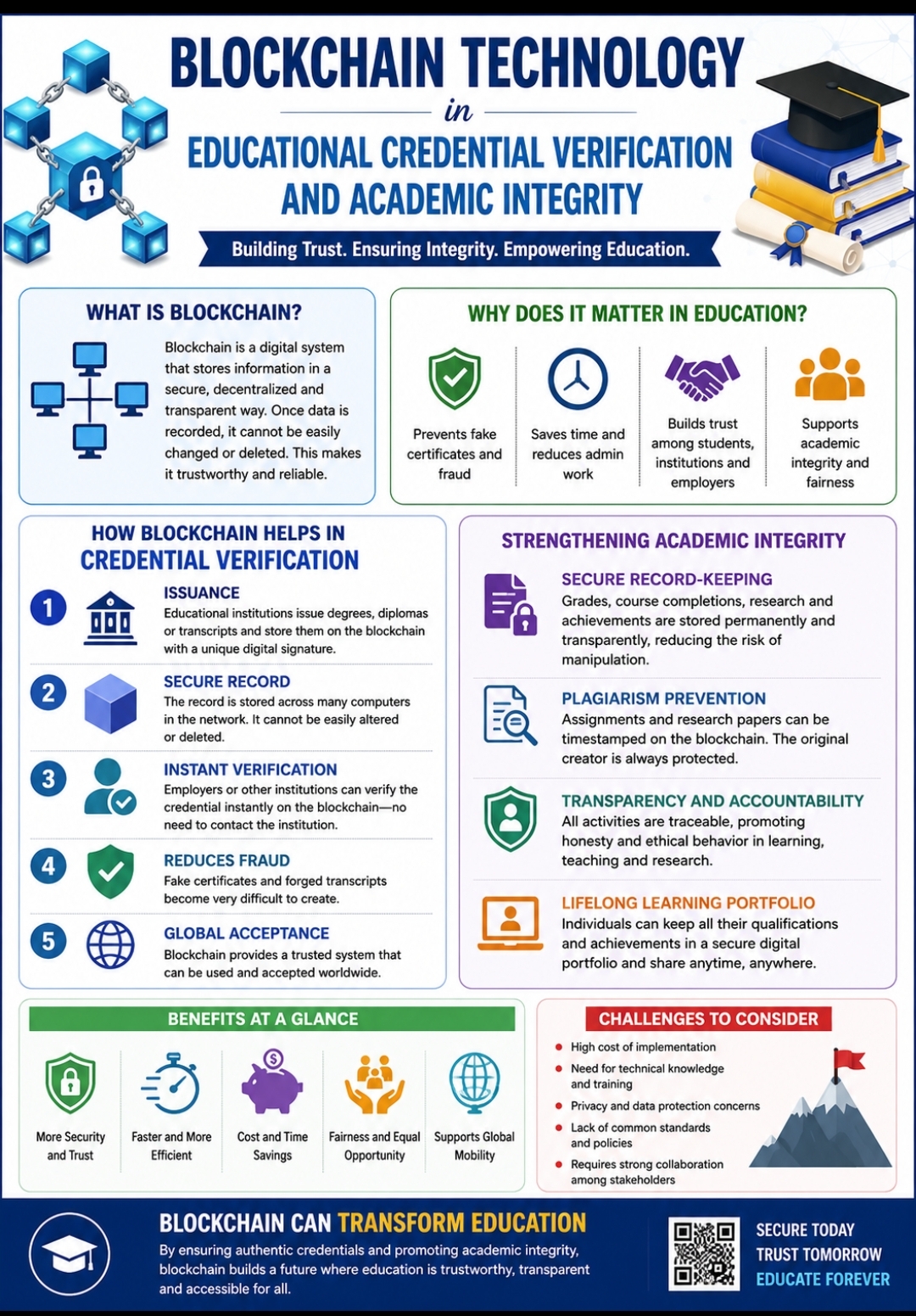
Blockchain is a secure and decentralized digital system that facilitates the safe storage of information. Rather than storing data on a single site, blockchain stores information across numerous computers on a network. Once data is stored on a blockchain, it is extremely hard to modify or erase that data. This is good indications of the technology's reliability and security. While blockchain technology is often linked to cryptocurrencies, it can be utilized in various other fields apart from digital currency. An application that has great potential is in the educational field.
In the context of education, the term credential verification is used to indicate the process of verifying that a student's certificate, diploma, degree, or transcript is valid. This process is often time consuming, costly and slow. Employers will sometimes have to call schools or universities to check the candidate's credentials. In some instances, institutions may take several days or weeks to respond. The other risk is of fake paperwork being submitted by people who want to take up employment or enroll in an academic program.
With blockchain technology, these challenges can be overcome by providing a safe and secure digital record of academic achievement. The school can publish the award on a blockchain network when the student graduates. Each credential is digitally signed, ensuring its authenticity. The credential can be instantly verified by any person authorized without having to call the institution. This not only helps save time but also decreases administrative tasks. I would like to think that this type of system can make verification a lot easier for both the educational institution and the employer.
One crucial benefit of blockchain technology is that it diminishes the risk of certificate forgery. With blockchain records being hard to fake, the amount of bogus degrees and transcripts is severely reduced. With a blockchain job credential, employers can easily check whether the credential is genuine or not. This builds confidence in academic merits and promotes the distribution of employment and opportunities to the deserving.
Furthermore, blockchain technology is used to ensure academic integrity. Academic integrity is honesty and ethics in learning, teaching and research. It covers plagiarism, cheating in tests, falsifying information and other dishonest practices. It's crucial to uphold academic integrity because it helps to preserve the worth of education and fairness between students.
Record management are one way blockchain can help foster academic integrity. Records of academic progress, course completion, research papers and evaluation outcomes can be recorded on a blockchain. The permanent and transparent records make it hard for anyone to influence grades or change academic records. This helps build confidence in the educational system.
Another use of blockchain is to combat plagiarism. Research papers, projects and assignments can be recorded on the blockchain and be duly time stamped. The exact date and time that a document was created or submitted is indicated by a timestamp. The blockchain record can help demonstrate the originality of the creator if someone copies another person's work and attributes it to that person. This stimulates students and researchers to create their own work and respect intellectual property rights.
Furthermore, blockchain can enhance the administration of a lifelong learning record. A large number of people now qualify from a variety of institutions, online learning, training centers and professional bodies at various stages of their lives. It can be challenging to track all these achievements. In the blockchain world, people can have a secure digital portfolio, holding all of their educational records in a single location. I very much appreciate this concept as it enables individuals to readily showcase their success with their employers or educational institutions as necessary.
However, blockchain technology has its drawbacks. A difficulty is the cost of implementation. Implementing a blockchain system can be a costly endeavor for educational institutions. Another challenge is the technical knowledge. Staff and students at schools and universities need to be trained to effectively use the technology. There are issues of privacy and data protection too. Sensitive student information should be stored securely by institutions and accessible by only those who are authorized.
Moreover, there is a need for education to embrace blockchain through collaboration among numerous stakeholders. The development of a set of common standards and policies requires the collaboration of governments, universities, employers and technology providers. If the different blockchain systems are not compatible with each other, they will not be effective if they are not cooperated with each other.
To sum up, blockchain technology can revolutionise the verification of educational credentials and academic integrity. Offers a safe, clear, and effective means of storing and confirming academic records. The blockchain technology can help enhance trust in education by lowering fraud, eliminating data manipulation, and making plagiarism easier to detect and verifying credentials. Despite the obstacles of cost, technical needs, and privacy, the advantages of the technology are strong. In the realm of education, blockchain could hold the key to enhancing the credibility and integrity of academic institutions globally, as they increasingly work to transform their operations.
https://x.com/i/status/2038990196453126632
https://coinmarketcap.com/currencies/pussfi
https://x.com/i/status/2036134193260802100