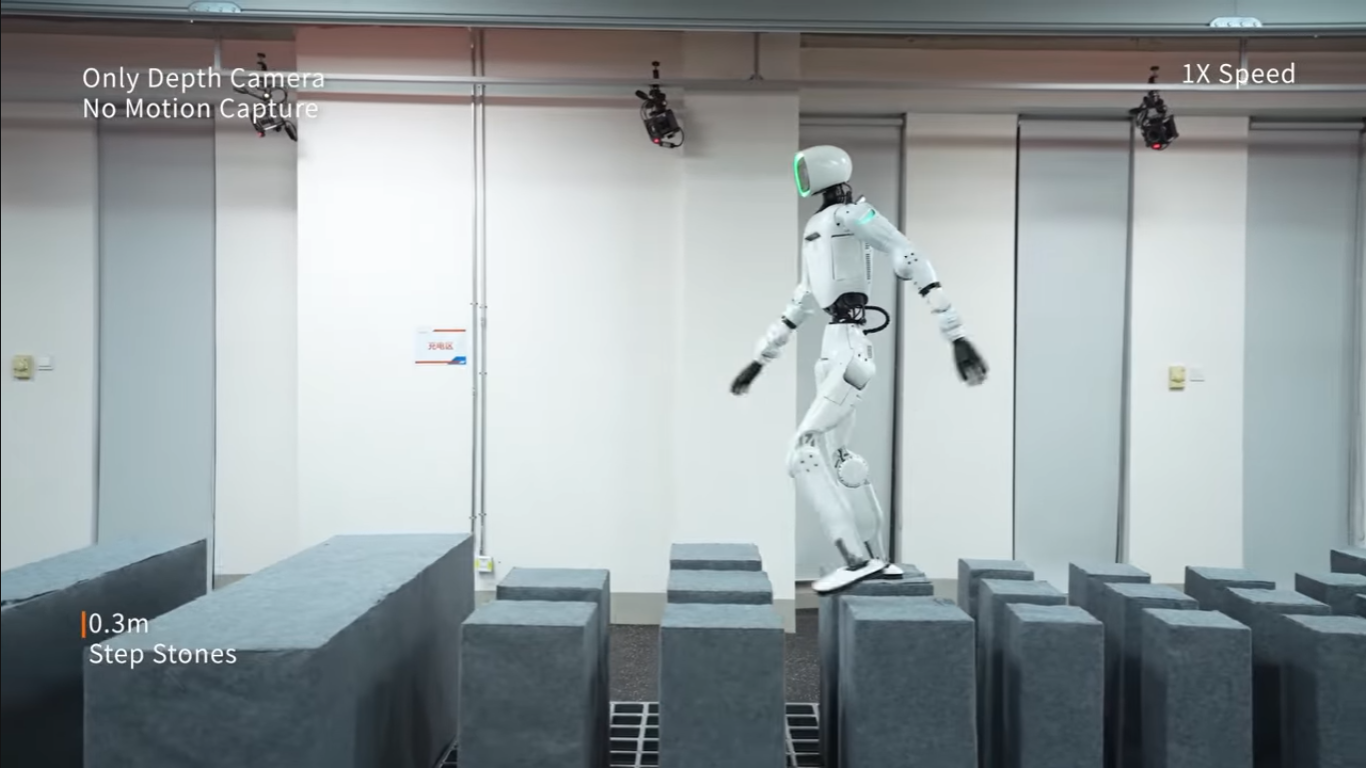
Robotic tests in real environments.

in Popular STEM8 hours ago

Robotic tests in real environments.


Climbing a continuous 17-story staircase, relying solely on a depth camera with no external sensors, no pre-programmed maps and no help from sophisticated motion capture systems used in laboratories, that just happened and the TienKung Omni was pushed to the limit in a sequence of real-world tests that tested its physical endurance and built-in intelligence.


Instead of remaining inside sterile laboratories, it was placed in real scenarios where uneven floors, sharp curves and unpredictable obstacles replace perfectly planned environments. The secret of this demonstration is precisely the absence of any external help. The humanoid depends exclusively on an integrated depth camera that functions as its only eyes; the sensor constantly calculates the distance of objects around it, digitally reconstructing the relief of the environment so that artificial intelligence determines where to position each step.


This three-dimensional perception allows the machine to operate both under bright daylight and in dark environments, where conventional vision systems could fail. In a seemingly simple task for a human being to climb steps, the machine needs to recalculate the balance of the torso and the force applied by the actuators in every fraction of a second to avoid a backward fall. After that, the robot navigated internal corridors full of curves and obstacles, navigating completely autonomously.


The test concluded with prolonged walks in outdoor environments and uneven terrain, as well as bending and practically crawling, testing the wear and tear of the joints of the mechanical structure and electronic systems.


Sorry for my Ingles, it's not my main language. The images were taken from the sources used or were created with artificial intelligence