Can energy be extracted from a black hole?
in Popular STEM2 days ago

Can energy be extracted from a black hole?


On July 12, a news story appeared with the headline "Physicists Recreate Energy Extraction from a Black Hole in the Lab." Physicists at the Advanced Science Research Center in New York succeeded in recreating—within a laboratory setting—the famous theoretical process of extracting energy from a rotating black hole. This theory was originally proposed by Roger Penrose over 50 years ago and later expanded upon by Jacob Zel'dovich.
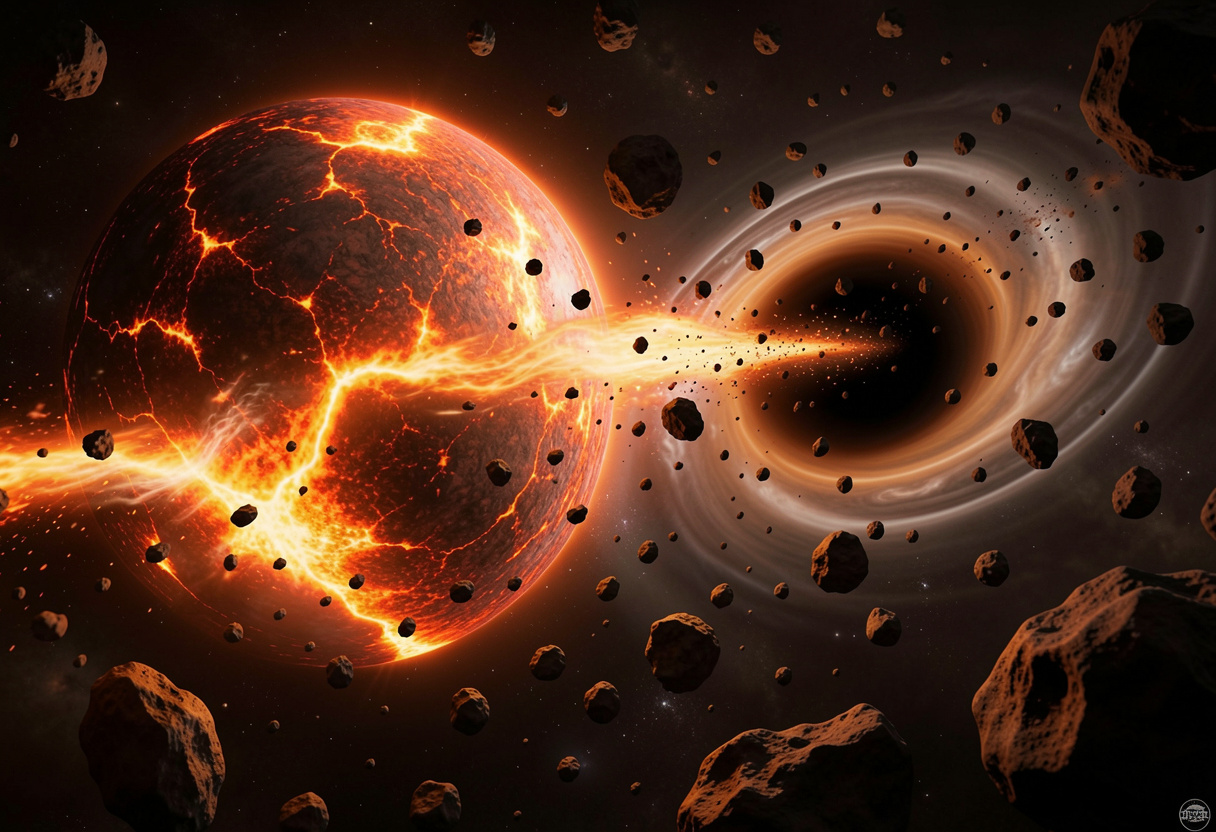

To explain the Penrose-Zel'dovich theory simply: it involves a rotating black hole. The key lies in the black hole's "ergosphere"—a region found in rotating black holes (and it is believed that all, or the vast majority of, black holes rotate). Within this ergosphere, waves or particles can be used to extract energy from the black hole's rotation, emerging amplified in the process. This phenomenon is known as superradiance or the Penrose-Zel'dovich effect, named after the two researchers: the one who proposed the idea and the one who refined it.


The ergosphere is the region of spacetime surrounding a rotating black hole where space itself rotates along with the black hole; it is the area of ​​maximum distortion, where spacetime is dragged by the rotation of the black hole's mass. However, the ergosphere is not the event horizon—a distinction that proves useful for extracting energy. At the horizon, time stands still for a distant observer, whereas within the ergosphere escape is still possible; it remains the boundary zone bordering the point of no return.


How does this work? Imagine a carousel or a wheel spinning very fast; if you throw a ball toward it in the right direction and bounce it off that spinning object, the ball will fly back at you—and at a higher speed, too—because it has captured some of the carousel's energy; it rebounds with tremendous force. The carousel will spin a little more slowly, of course, because it has transferred some of its rotational energy to the ball shooting away.


Something similar happens with a black hole, though involving distorted spacetime geometry; this entire process violates no laws of physics. The energy comes from the black hole's spin. While the carousel analogy is useful, a carousel isn't a black hole. A black hole is more like a grumpy neighbor who keeps your ball; the challenge is getting them to return it—or make it bounce back with extra energy. In the case of a black hole, you’ll only get half the ball back—though, if everything goes right, that half will emerge with immense energy.


You need to have two parts, with one falling inside the event horizon—specifically, both parts reach the ergosphere, that zone where spacetime is distorted. The key to this mechanism is that one part breaks off and falls into the black hole (crossing the event horizon); this generates energy for the piece that didn't fall in, causing it to shoot outward with far more energy than the piece that fell inside.


This happens because, upon splitting within the ergosphere, the falling fragment acquires negative energy—relative to the observer's perspective—while the other possesses positive energy. The total sum remains positive, so no laws of nature are broken and nothing anomalous occurs; however, part of the black hole's rotational energy is transferred to the escaping fragment due to this combination of positive and negative energies. The falling piece has negative energy, while the exiting piece leaves with positive energy. This requires incredible precision, but it works whether the object is a particle, a ball, or a spacecraft; in other words, if a spacecraft is trapped by the black hole's gravity, you could use this as a last resort—aiming it just right. If you write science fiction novels, you can use this as a final option: just remember the Penrose-Zeldovich process when it comes to escaping a black hole.


At that point—given the right circumstances and trajectory—if you execute the maneuver correctly, you do have to sacrifice half your ship; however, you would be catapulted out with significantly more energy and escape the black hole. If you get it wrong, both parts fall into the black hole, or you end up trapped in the area because you fail to gain the extra energy needed to escape.


Study Source


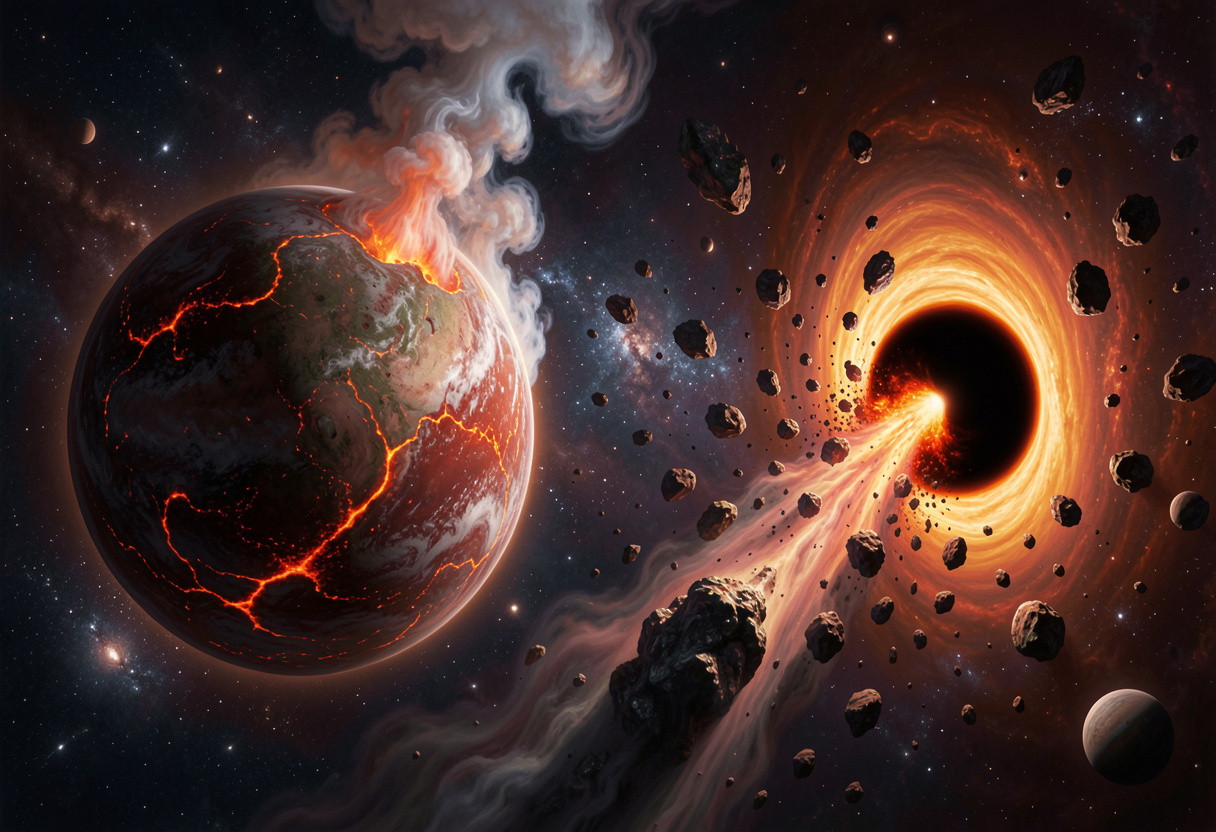
The images without reference were created with AI
Thank you for visiting my blog. If you like posts about #science, #planet, #politics, #rights #crypto, #traveling and discovering secrets and beauties of the #universe, feel free to Follow me as these are the topics I write about the most. Have a wonderful day and stay on this great platform :) :)


! The truth will set us free and science is the one that is closest to the truth!